Night Hiking
Keeper of List of Bay Area Hikes and Hiker of Said Hikes Tom Mangan (Two-Heel Drive) posts several pieces today about Bay Area hikes, including a night hike at Sunol Regional Park:
Guided hikes last approximately 1 and 3/4 hours and become more dark and spooky as the night progresses …
Sounds like fun.
It got me thinking again about the pleasures (and a few complexities) of hiking at night. I’m also thinking about this because in the next few weeks it is quite likely that I’ll hike after dark. In the Sierra. Seven miles. Alone. Uphill. More on that eventually.
Let me get the “complexities” out of the way first. First of all, you may have noticed that does tend to be dark at night. Unless you have great night vision, know your route extremely well, or have clear terrain and a full moon you’ll need to use a headlamp. While one can get around camp pretty well with a tiny LED model, most would agree that real night hiking demands a more serious headlamp and perhaps extra batteries. Route-finding can be an issue. It is very easy to miss a turn and suddenly be trailless. The terrain itself becomes more of an issue since your headlamp pretty much illuminates only a small area in front of you – it is easier to trip and lose your balance.
All of this duly noted, there is a peace and calm about night hiking that can perhaps only be approached on a quiet hike or ski in windless conditions after a recent snow fall. The fact that you cannot see details focuses your mind in a very unique way. If you value the experience of being alone – at least occasionally – you’ll get there more quickly after dark. You’ll know what I mean the first time you stop for a “pack off” break on a night hike.
And one of the best experiences comes if you are hiking after dark to a place where you will meet friends. Few things are better than emerging from solitude and darkness and into a circle of light at the campsite where the rest of your party waits.
Hopefully with hot soup… :-)
Anatomy of a Sierra Nevada 'Aspen Blitz'
It is September – actually it may October when you read this – and time to chase the aspens in the eastern Sierra. I made my first serious attempt of the year yesterday. Here’s how the madness unfolded…
On Friday night – pack stuff for the day, including enough gear that I could stay out overnight if necessary. Try to get to bed early but more or less fail. :-)
Up at 3:30 a.m. on Saturday morning. After a quick bagel and an espresso I’m on the road before 4:00 a.m. I drive out of the Bay Area and across the Central Valley in the dark and begin to see a bit of light in the east before Jackson. Fill the tank in Jackson and head on toward Carson Pass. The sun rises a bit before I reach Kirkwood, so I stop and shoot a few sunrise photos looking north towards peaks around Lake Tahoe… and including an inch of snow in the foreground.
I stop to take a few photos at Silver Lake and eventually work my way over the pass. I stop on the other side to look out over Hope Valley which holds many stands of aspens, quite a few of which are starting to turn yellow. I do a bit of photography in Hope Valley as far down as Sorenson’s and then head on down toward Woodfords where I turn right and head up past Markleeville to the start of Monitor Pass.
Lots of aspens on Monitor Pass beginning with some impressively colorful stands right along the road at the base of the climb. There is another brilliant stand near a lake about half way up, and the giant aspen groves near around the top of the pass are coming into condition. I stop at the pass and shoot in a the groves here for awhile before starting down the other side. (Near the top of the descent I make a mental note to return to several spots in this area later in the day should I return by this route.)
At the bottom of Monitor Pass I turn south on highway 395 and eat lunch as I drive toward Walker. After climbing the narrow Walker River canyon beyond town, the land opens up before Sonora Pass where many large groves of aspens are visible up high. I don’t go up that direction this time, but continue south with time for a detour out on a a dirt road south of Sonora Pass road. This takes me up to some very colorful groves – though the light isn’t great this time of day – but the road becomes a bit rougher than what I’m in the mood for, so I head back to 395 and on towards Bridgeport.
After passing through Bridgeport I take another dirt road south of town, those one marked “Green Creek.” This road is mostly in pretty good shape, and it travels though high and interesting country that would be worth the drive even if the aspens weren’t there. Eventually it climbs though some outstanding aspen groves up high – this is an area that is visible from Conway Summit below in 395. After the aspens the forest changes to coniferous trees and shortly joins the road to Virginia Lakes, where I stop for a few photographs.
Leaving Virginia Lakes I calculate my remaining daylight hours and decide a) that I have time to visit Lee Vining and b) that I’ll return the way I came and shoot at those spots I noted earlier on Monitor Pass later in the day. I pass by some aspens stands as I descend toward Conway Summit and the junction with 395 – these will be good in a few days – and turn right on 395. The groves just south of Conway Summit are very colorful but there seems to be no place to pull over, so I continue on to Lee Vining.
After buying $15 worth of gas for $20 and getting an espresso and a snack at “Latte Da” (where, by tradition, I sit on the porch for ten minutes) I start to retrace my path. When I arrive back at Conway Summit the sun is lighting the huge aspen groves there from behind so I stop to shoot some multi-image panoramas. I leave Conway Summit with the goals of getting back to Monitor Pass in time to shoot some hills on the east side of the pass before the Sierra crest blocks that light and then shooting at the pass in the last light.
I arrive at the Monitor Pass road more or less on schedule. After stopping to photograph some hills near the bottom, I head up to near the top where I can get a panoramic shot of the valley and ridges to the south and east of the pass. Then it is on up to the pass proper where I spend 15 or 20 minutes shooting the colorful light in the aspen groves at the pass as the sun drops. From here I quickly head just over the pass to a spot I had earlier identified as a possible sunset shoot location, and I arrive just as the last light is going. I think I may have just barely gotten a decent shot here, but now the light is gone and it is time to head home.
At the bottom of Monitor I decide that the better road over Carson Pass is probably a better bet than the slightly shorter but twistier route over Ebbetts, so I turn right, pass through Markleeville and Woodfords and climb over Carson Pass as the last light goes. Now it is just a plain old long drive home, with a stop along the way for some disgusting fast food and some Starbucks coffee. 600 miles later I’m back home at 11:45.
Next weekend I may take a somewhat more civilized two-day trip back to the aspens, though this time I’m thinking I’ll head south of Lee Vining towards June Lake, Rock Creek, and the North/South/Sabrina Lake area…
More Proof of Aspen Color
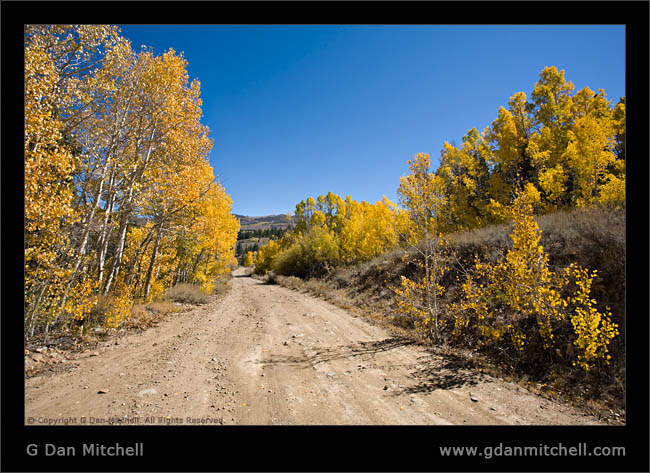
Aspen-Lined Road. Sierra Nevada, California. September 29, 2007. © Copyright G Dan Mitchell
Just a “get out of the car and shoot” photo on a back road just south of Bridgeport…
Last Day of Summer…
… and it felt much more like fall today. It rained – which is a bit unusual for central California this time of year – and it was cool. I hiked at Almaden Quicksilver Park and walked through newly fallen autumn leaves and past meadows filled with golden dry grass. It sure didn’t feel like summer any more!
Tioga Pass Snow – September 21, 2007

Here’s the evidence – snow at Tioga Pass this morning. (Photo from the Tioga Pass webcam.) While always exciting, getting a dusting like this is not terribly unusual in late September or early October. It usually melts out within a day or so. However, there is an interesting weather forecast for later today – the word’s “heavy snow” are included for portions of the high country. Hard to believe that, but we’ll see.
Wow, That's Early!
West Coast Imaging’s blog reports that there is snow on Tioga Pass, and backs up the claim with photographic evidence. In the long run, who knows what it means – it could easily turn warm again, as it often does in late September and early October. But still, kinda’ gets the winter juices going, doesn’t it?
Tom Goes to Point Lobos
So soon after my visit that we might have almost passed on highway 1, Tom Mangan also visited Point Lobos. Sounds like we’re on to something with the September visits to this park.
As for me, continuing my theme of visiting the shoreline, yesterday I spent a day at Point Reyes National Seashore. More on this soon, but a few comments now.
I’m almost embarrassed to say that this was actually my first visit to this Bay Area treasure. I’ve driven past the park before, but that’s it.
Doing a one-day up-and-back trip from the south SF Bay meant that I was up at 5:00, on the road shortly after that, and didn’t return until about 10:30 p.m.
For me at least, the appeal of this park is different than that of my beloved Sierra Nevada. Perhaps that is partly because the terrain and the flora are not so different from the hills around my home. But there are some places there that do get my attention. I hiked out to Arch Rock and sat there for alone for awhile. I visited the north shore on my way to Point Reyes itself, and the surf is astounding on these beaches facing the open Pacific to the north. At Point Reyes near the lighthouse at sunset, the wind was wild and the sky was spectacular.
Wildfire Photographs
From Firefighter Blog:
Desiree’s Zaca Fire Photo Array. If you follow this blog regularly you know I am a huge fan of Copter Chick Desiree Horton. As you may know Desiree and her crew spent many weeks on the Zaca Fire. Click here to view her unbelievable images of the Zaca Fire from the air. By Mike. [Firefighter Blog]
If you want to see some very interesting photographs of California wild fires (and some aspects of how they are fought) take a look at this link.
Sierra Weather: What Was I Thinking?
I’m just back from a nice little near-the-end-of-the-season pack trip out of Tuolumne Meadows – I spent a couple nights out in the Young Lakes basin. I’ll probably write a bit more about the trip and post some photos later, but for now here’s a little story about me and the weather.
I often follow Sierra weather forecasts even when I’m not going to the mountains, but before a pack trip I often consult several sources before I leave, including the Weather Service forecast discussions. By wading though the somewhat technical verbiage and reading between the lines I can often pick up important hints that may affect my choice of destination and – more often – what gear I take.
This past Saturday and again on Sunday morning before I left, the basic thread was that we were going into a fairly benign weather week, with some cloudiness around the Sierra crest on Sunday and then a clearing trend. So I decided to leave my tent at home and take only my bivy, even leaving my small Siltarp in the car to minimize weight.
The short story is that I got the chance to find out what it is like to camp in a bivy in the rain. The longer story follows, and includes a little lesson on what happens when I focus too much on weather reports… and perhaps not enough on the actual weather.
Nothing too surprising happened on Sunday, the first day of my little trip. I knew that there would be some clouds in the afternoon – as a photographer I actually looked forward to this bit of interesting weather – and a slight possibility of some showers. So I wasn’t at all surprised when the clouds thickened and it started to sprinkle a bit by the time I was a mile or so from my camp at Lower Young Lake. This was very minor weather – the sort where you put the pack cover on “just in case it really starts to rain,” and keep the rest of the rain gear near the top of the pack. The sprinkles pretty much passed by the time I set up camp.
The morning was beautiful on day two with blue sky (though hazy, perhaps from those September California fires) and a stray cloud or two. I decided to wander on up past Middle and Upper Young Lakes, and perhaps continue on up to a further lake along the route to Mt. Conness, or possibly travel to nearby Roosevelt Lake. In light of the generally nice weather and bearing in mind the forecast of fair weather I had read before leaving, I chose to travel light, carrying only camera gear and some water – I carried no rain gear or other clothing beyond what I wore.
As I walked the short distance to the two upper lakes I was a bit disappointed in the flat light under increasingly cloudy conditions. Oddly, having that weather forecast so fixed in my mind, I didn’t really even consider that it might rain – in conditions that would have caused me to think about this in normal circumstances. After photographing at the upper lake I thought I’d wander up to a point on a low ridge where I could either continue to the upper lake or head over toward Roosevelt. It was here that I first heard thunder and then felt a few rain drops. I thought something like, “That’s odd. It shouldn’t rain today,” but I decided that it might be a good idea to reconsider my plans and head back toward the lower lake.
A couple minutes later it was raining enough that I had to stop and put a rain cover on my camera bag. As I dropped through a steeper section of the route between the middle and upper lake I realized that I was starting to get significantly wet. I found a partially fallen tree that provided shelter until the rain slacked off a bit, and then continued on for another 15-20 minutes in the drizzle to reach my campsite.
Fortunately, I had zipped my bivy up tight, so my camp was secure and dry. Now I had the opportunity to figure out how to try to keep it that way while getting out of wet clothes and into the bivy. It went something like this: Take boots off and stuff them into a large plastic bag along with pack and few other odds and ends. Move food canister close to bivy in case rain continues during dinner. Open bivy and push sleeping bag away from the opening. Standing in the opening of the bivy, quickly put on additional poly layers and put the damp pants and shirt on over them. Zip into the bivy while lying on top of the sleeping bag and let body heat do its work of drying the damp clothes. Listen to thunder and rain and hail on the bivy. When rain stops, sit up in bivy and fix dinner… and then zip up again for after-dinner showers.
It finally stopped and, yes, a bivy is a decent though cramped shelter in light rain. (Remember to bring a book…)
A lesson learned: Next time pay a whole lot less attention to what the weather is supposed to be and a lot more attention to what it actually is doing.
Subscribe

-
Archives
- April 2012 (1)
- January 2011 (1)
- September 2010 (2)
- August 2010 (1)
- July 2010 (4)
- June 2010 (6)
- May 2010 (11)
- April 2010 (4)
- March 2010 (1)
- February 2010 (1)
- January 2010 (5)
- October 2009 (4)
-
Categories
- Abstract
- Black and White
- Castle Rock
- Commentary
- Death Valley
- Desert
- Environment
- Equipment
- Events
- Gear Reviews
- Green World
- History
- Mission Peak
- Mono Lake
- Mount Shasta Area
- News
- Ocean
- Owens Valley
- Pacific Northwest
- People
- Photography
- Places
- Point Lobos
- Quicksilver
- Quicksilver Historical
- Quotable
- Random
- San Francisco Bay Area
- Santa Teresa
- Sierra Nevada
- Site News
- Technique
- Trails
- Trips
- Uncategorized
- White Mountains
- Wildlife
- Yosemite
-
RSS
Entries RSS
Comments RSS
 Dan's Outside
Stupid, Pathetic, or Both?
Just saw an ad for a local auto dealer. I won’t name them here since they might like the links…
The ad goes something like this. Pictures of calving glaciers, polar bears, trees. Warm sincere voice over saying, more or less, “[Stupid Dealer X] shares your concern about global warming. That’s why for every truck or SUV you buy we’ll plant 20 trees.”
I’m stunned.
Let’s see. Because they “care” so much about global warming… they’ll reward you for buying a vehicle that contributes to the global warming. Huh?
If they really cared about global warming – and, of course, they don’t – it would be far more useful for them to plant 20 trees for every “truck or SUV” that we don’t buy…
Share this:
October 4, 2007 Posted by gdanmitchell | Commentary | Comments Off on Stupid, Pathetic, or Both?