Sierra Fall Color Season About to Start
The autumn color season in the Sierra Nevada should start very soon. Actually, if you count – as I do – the dry grasses and the high elevation ground plants going dormant, it has already begun. But the real show is the turning of the aspens, mostly in the eastern Sierra, starting around the very end of September and likely peaking during the first week of the month. If conditions are right, it can last as long as the middle of October, but earlier is always better.
Several web sites have posted fall color guides in the past, and since timing is so critical it is a good idea to follow the as the time approaches. One site that is new to me is a US government site that reports on fall colors nationwide. Another that I’ve often followed in the past is the California Fall Color site, though it doesn’t (yet) appear to be active. In addition, I’ll summarize what I know and what I hear about Sierra fall color once the curtain begins to rise on this year’s show.
Tuolumne Gas Station Will Close for Upgrades
From a West Coast Imaging blog report:
Tuolumne Gas Station Closed For Upgrades Beginning Monday, 9/8, the Tuolumne Gas Station will be temporarily closed for vapor recovery and dispenser upgrades. Fuel will not be available from 9/8 until 9/29. The sport shop will remain open for business and propane will still be available through 9/21, daily from 9 AM to 5 PM. Fuel is still available at Crane Flat Station 24 hrs/day. (NPS Press Release)
I virtually never buy gas there anyway, but this is good to keep in mind if you aren’t one to watch the gas gauge carefully. Since I most often come in from the west side I usually tank up in Oakdale or possibly near Groveland on the way up – prices are a lot lower there than inside the park. If I’m coming up from the east side I usually try to get gas in Bishop – again, considerably lower prices here – or possibly Mammoth if I have a reason to go up there.
The gas prices in Lee Vining are notoriously high – generally among the very worst prices in the eastern Sierra – so I avoid purchasing gas there if at all possible. (Though a stop at the Mobil station at the junction of Tioga Pass Road and Highway 395 is worth it for the food. Really. Get the fish tacos. That’s all I’ll say.)
More About The Trans-Sierra Pack Trip
Early this month (August 4-12, 2008) I completed a tran-Sierra pack trip with my talusdancers friends. I still plan to eventually post “the story” along with photos, but since the trip was two weeks ago and I still have work to do on the photographs I’m writing up a quick overview here with the day by day account to come later.
The broad outline of the trip was to travel the “High Sierra Trail” west to east from Crescent Meadow in Sequoia National Park (located very close to Moro Rock), over the Great Western Divide at Kaweah Gap, up the Kern River canyon to Junction Meadow and the climb up Wallace Creek, down the John Muir Trail (JMT) to Crabtree Meadow, and then over the peak and out to Whitney Portal on the east side. I have been on sections of the trail several times, especially in the area in and to the east of the Kern, I followed the HS Trail out to the cutoff to Elizabeth Pass on my first solo trip many years ago, and my wife and I did the whole HS Trail many (many!) years ago. I was interested to see how much of the route would seem familiar to me.
The first challenge for a trans-Sierra trip is setting up the car shuttle, and it is a major issue on this trip. The drive between Whitney Portal (where we left two cars) and Three Rivers (where we stayed the night before the trip) takes about four and a half hours – and we would need to repeat it at the end of the trip in order to retrieve the cars left at Crescent Meadow. As far as I can tell, there is simply no good way to avoid this issue.
At Crescent Meadow the trail begins in relatively lush forest (by Sierra Nevada standards) with ferns beneath the trees in places, and then it quickly crosses a gap in the ridge after which the trail largely contours along the north side of the canyon of the Kaweah River as it heads toward its source on the Great Western Divide. The trail alternates forested sections with wide open sections affording expansive views of the canyon, the Great Western Divide, and the foothills of the Central Valley. We passed Mehrton Creek – where I camped on my first trip through here – and continued on to our camp at Nine Mile Creek.
On the next morning the first portion of the trail was not terribly different from what we had hiked on the first day – mixed forest and open terrain and at roughly the same elevation. After a short distance and a small climb we arrived at Bearpaw Meadow where there is a ranger station and a backcountry camp much like the High Sierra Camps in Yosemite. We all stopped to enjoy the now close-up view of the peaks of the Great Western divide before continuing on. At this point the terrain began to change as the trail followed a rather “interesting” route along rocky cliff ledges above the increasingly steep valley below. After crossing a major creek on a new bridge (from which you could ponder the wreckage of the old bridge below) the trail began the climb into the basin holding Hamilton Lakes. The climb is not too bad, but at the end of the day it seemed somewhat hard. We soon arrived at popular Upper Hamilton Lakes, from which we could view the route for the next day’s hike to Kaweah Gap.
The next morning some of us started early in order to get a head start on the steep 2500′ climb to Kaweah Gap, while others got a later start. The trail climbs steadily across the headwall of this basin, and includes some quite impressive examples of trail engineering – including the only “trail tunnel” I’ve encountered in the Sierra. Near the top of the steeper section the trail crosses wildflower fields fed by many small stream, and soon after that it arrives at Precipice Lake. (You may know this lake from a very famous Ansel Adams image shot in 1932.) We paused here – and I tried to pay homage to Ansel with a few photos of my own – and then headed on up the rather alpine final section to the gap, passing by small tarns and alpine meadows before this high point. From here the view opened to the east to the Kaweahs and to the south down Big Arroyo, into which we descended to reach our camp site at the old cabin along the creek.
On day four we began the climb to Chagoopa plateau, the large flat area at the south end of the Kaweahs between Big Arroyo and the Kern. After reaching the plateau – and wondering about the gathering clouds – we walked another mile or so and then turned off on the loop to Moraine Lake, our next camp.
On the next morning we began by crossing the Chagoopa Plateau on a trail that went through meadows and forest (many of which showed sights of fire) and past expansive views of Kaweah Peak before rejoining the High Sierra Trail. After this junction the trail began the large descent into the Kern River Canyon, and we gave up all of the elevation we had gained up until this point and then some by the time we hit the canyon floor. We passed over a very rough section of “new” trail that bypasses the old route along the river as we headed upstream to the Kern Hot Springs – where anyone in their right mind would camp and soak in the riverside rock pool.
After considering the rest of our itinerary and realizing that we had to do at least one really tough day to finish according to our plan, we decided to make the next one our long day. We started early with the fairly easy 7.5 mile walk up the Kern to Junction Meadow, rising perhaps 1000′ or so in this distance. We took a long lunch break here and then started the real climb of a bit more than 2500′ to the JMT junction at Wallace Creek. I think we all know that this 13 mile day with a 3700′ climb would be tough, but we all managed to avoid mentioning it in conversation – which is one way to deal with a challenge like this. Suffice it to say that we were tired when we arrived at the JMT and set up camp in the late afternoon.
The following day’s hike wasn’t so tough. We started with the section of the JMT that rises south of Wallace Creek, crossing moraines, forests, meadows, and a few intermediate valleys on its way to Crabtree Meadow. This is the location of another backcountry ranger station and the last place that one doesn’t have to use “wag bags” (look it up…) so we had considered camping here. However, this would have increase the total climb to the summit of Whitney the next day by about 1000′ and by several miles – so we decided that it would make more sense to head on up to the traditional “last camp before Whitney” on the west side, Guitar Lake.
Finally, the next day was summit day. Most of the group intended to camp on the summit of Whitney, but I have some breathing issues at night that made me inclined to not join them. With this in mind I got a bit of an earlier start than most of the group. The hike up from Guitar Lake is somewhat serious business – in climbs very steadily and the elevation can take an increasing toll on speed and endurance as the trail rises to the trail crest. We all met up at the junction with the trail coming up from Whitney Portal before heading on to the summit, with me carrying only photo gear and a few other items and the rest of the group equipped for a night on the summit. After the inevitable summit photos, I left them to their high camp and headed back to pick up my pack and head over the crest and on down the east side. I passed by the “trail camp” at the base of the first section of steep switchbacks and kept going to Outpost Camp, where I joined a lot of other backpackers, most of whom were likely headed up the peak the next day.
There isn’t a lot to say about the final day since I was only perhaps three miles or so from the trailhead, a distance that I completed by mid-morning – with time left for a huge breakfast at the Whitney Portal store. (You have never seen a pancake as big as what they sell there. Really.) By midday the whole group had arrived – reporting that they had a good overnight on the summit – and it was time to put the reverse car shuttle in motion.
And that’s it for now… Photos later.
A New Terrain Rating System?
Hikers and climbers are familiar with systems designed to quantify the difficulty of particular routes. Those of us who occasionally wander across trail-free Sierra passes relax when we see one rated as class 1 but prepare for some hard slogging when the pass is rated class 3. Climbers are familiar with the various sub-flavors of class 5 – 5.1 being easy and 5.13 requiring you to be part fly and part contortionist.
Tom Mangan shares an alternative system that he recently encountered while reading a post by a city woman.
Rating system:
- Heels: So easy you can hike it in heels
- Flip-flops: Too long or hard to hike in heels, but flat flip-flops would work
- Pumas: A nice stroll not much harder than walking in the city
- Trailblazers: If you want to be nice to your feet on this hike, they’ll need some more serious protection and support.
- Hiking boots: Pull out the ugly shoes and summon your closet granola. This hike is going to kick your ass.
I love it!
(Click the links for more…)
Turtle Don on Mount Whitney
Turtle Don on Mount Whitney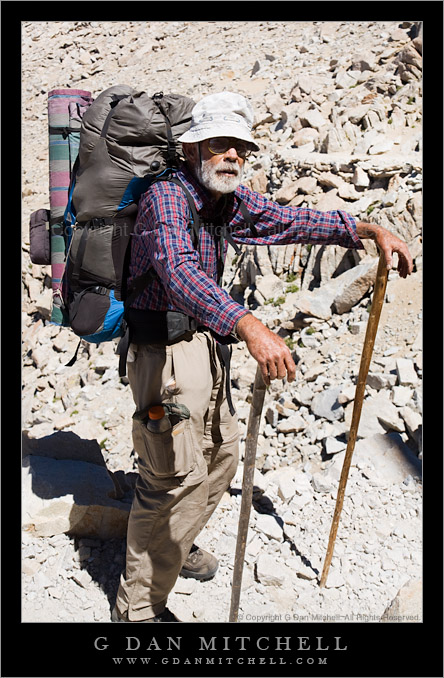
But you would be very, very wrong.
He wasn’t in a hurry so we stopped and talked a bit – and he shared parts of a story that I eventually discovered he shares with everyone he meets on the trail. He goes by the name of “Turtle Don,” a trail name he said he gave to himself while thru-hiking the Appalachia Trail (yes, that’s right!) recently. On a day when everyone seemed to be passing him he came upon a little turtle – the first thing going slower than he was on the trail.
I didn’t quite catch the whole story, but he has apparently hiked several other major thru trails in the US. Now he was/is working on the Pacific Crest Trail. He’s not exactly thru-hiking it (e.g. doing the whole thing in one uninterrupted rush) but he had already completed a good portion of the Southern California desert section and was now working his way north through the Sierra in 8-9 day segments, and meeting his wife between these intervals to stay in a motel and resupply.
Don is 74 years old. He gives me hope that I have more than a few years of backpacking left in my legs and lungs! Don is slow, but he seemingly cannot be stopped. After I left him – finally tearing myself away as he continued his stories – I continued on up the mountain thinking I wouldn’t see him again. Not so. As I took a break at the junction to the final two-mile traverse to the summit of Whitney there he was, slowly and steadily working his way up this very high and very exhausting trail. He arrived at the junction – where I made this photo – and we talked a bit more before I continued on to the summit. Later, as I was descending back to the trail junction, I found him still working his way towards the summit where he planned to spend the night!
Photography and text copyright G Dan Mitchell – all rights reserved.
How DEET Works
The most common (and only effective, in my view) mosquito repellents are based on a chemical known as DEET. As is sometimes the case with things like this, apparently scientists have known that DEET does work, but did not know why.
The old theory was, as I understand it, that DEET somehow “jammed” the mosquitos’ sensory system in a way that made it impossible to detect human skin. This sort of makes sense if you have ever observed how mosquitos respond to normal skin and DEET treated skin: in the former case they land and chow down; in the latter they may get close but they don’t usually even land. (The buzz still annoys the heck out of you, but at least you aren’t getting bitten.)
New research suggests a simpler process is going on. Basically, DEET smells bad to mosquitos so they avoid it.
While I’m on the DEET subject, a few other points based on my own experience. You may already know some of this, but perhaps the info will be useful to some who don’t.
“Back in the day” a lot of people got the “100% DEET” (or nearly 100% DEET) versions of the repellent, on the theory that the stronger the solution the better it would repel the little bloodsuckers. Turns out that this wasn’t quite right. It only takes a little bit of DEET to work effectively – and the 100% solution tended to go on way to strong is some places and not distribute to well to other places. Eventually manufacturers and users figured out that a lower percentage of DEET in a spreadable creme would work more effectively.
I haven’t been keeping careful track of these things, but this year when I bought a new supply I found several products that claim to be long lasting or to release slowly over time. This makes sense, as even in the dilute creme form the repellent sometimes seemed to wear off too quickly. From what I can tell from the newer versions that I’ve used this summer, there really is something to the claims of longer lasting protection.
Finally, DEET is poisonous to humans. Don’t overdo it, and do be careful about ingesting the stuff. Many years ago I made this mistake and the results were not pleasant. We encountered truly awful mosquito conditions at Booth Lake in the Yosemite high country – so bad that we slathered on the DEET (in the old, undiluted form) and mostly tried to stay in the tent. The problem occurred when we had burritos for dinner – as we handled and ate this dinner we apparently transferred some of the DEET to our mouths, and the result was not fun.
Back from the Sierra
I’ll only post a brief note today, but I returned from a 9-day trans-Sierra pack trip earlier this week. We followed the High Sierra Trail from Crescent Meadow on the west side of Sequoia National Park to its opposite end on the east side at Whitney Portal.
Busy Time Coming Up
I’ll be unusually busy – in a good way – during the next week plus a few days. So don’t be surprised if I don’t respond to emails right away. Please accept my advance apology, and be assured that I will get back to you eventually.
Dan
Subscribe

-
Archives
- April 2012 (1)
- January 2011 (1)
- September 2010 (2)
- August 2010 (1)
- July 2010 (4)
- June 2010 (6)
- May 2010 (11)
- April 2010 (4)
- March 2010 (1)
- February 2010 (1)
- January 2010 (5)
- October 2009 (4)
-
Categories
- Abstract
- Black and White
- Castle Rock
- Commentary
- Death Valley
- Desert
- Environment
- Equipment
- Events
- Gear Reviews
- Green World
- History
- Mission Peak
- Mono Lake
- Mount Shasta Area
- News
- Ocean
- Owens Valley
- Pacific Northwest
- People
- Photography
- Places
- Point Lobos
- Quicksilver
- Quicksilver Historical
- Quotable
- Random
- San Francisco Bay Area
- Santa Teresa
- Sierra Nevada
- Site News
- Technique
- Trails
- Trips
- Uncategorized
- White Mountains
- Wildlife
- Yosemite
-
RSS
Entries RSS
Comments RSS
 Dan's Outside
Early Eastern Sierra Fall Colors? Mixed Reports…
I’ve started to follow the various reports on the fall color season in the eastern Sierra. So far the reports are mixed, but something seems to be starting. Somre reports I’ve seen include:
The forest service fall color page that I mentioned in my previous post has become active… but it only shows a post from November 2007!
For my part, there is a chance that I may make a quick reconnaissance to the east side this weekend. It could take the form of my Epic One Day Aspen Chase adventute – e.g. a loop over Carson Pass, down Hope Valley, over Monitor Pass, on to the Lee Vining area, and then back over Tioga Pass. Or I might do it the other way around. Or, if I get some good reports from Sabrina, North/South Lakes I could try to head down there and spend at least one night camping.
Anyone else getting information on the aspens yet?
Share this:
September 22, 2008 Posted by gdanmitchell | Commentary | 3 Comments