Talusdancers Trip: Another Report
Owen, my good friend and fellow talusdancer has posted his account of our August week-long pack trip from Horseshoe Meadow to Symmes Creek via New Army Pass, Crabtree Pass, and Shepherd Pass. Among other interesting things, it includes something I cannot often provide at this web site – photographs of me backpacking! :-)
Bob at SFGate
I wondered if that other big Bay Area paper from the city to the north would cover the story of 4WheelBob’s climb of White Mountain. The question has been answered:
Peak performance in wheelchair. The words echoed in his head for years: “No excuses. No excuses. No excuses.” The mantra stopped only after one of the ultimate tests for a wheelchair hiker had been achieved. The Bay Area’s Bob Coomber became the first person in a wheelchair to summit 14,246-… > By Tom Stienstra. [SFGate: Tom Stienstra]
September Morning, Los Cerritos Pond

September Morning, Los Cerritos Pond. Calero Hills, California. September 2, 2007. © Copyright G Dan Mitchell.
Another example of why I like September… :-)
Best Time of the Year in the Sierra?
It is September, and my favorite time of the year in the Sierra Nevada begins now and lasts for the next two months or so.

Aspen Leaves. Bishop Creek, California. October 1, 2006. © Copyright G Dan Mitchell.
Labor Day weekend marks the last big rush of tourists to the Sierra – at least until the ski season begins. During the next two weeks the number of visitors to the high country will diminish greatly, and by the second half of September many places will seem downright (and delightfully) deserted. I’m lucky enough to have a schedule that gives me a lot of free time still for the next three weeks, so I’m planning to be up there several times this month.
What many people do not realize is that some of the best Sierra weather of the year occurs during September and early October. Early September can be like late August – warm, going on hot, and increasingly dry, especially in a drought year like this one. But some days are not like this, and a change is obvious – the sun sets earlier and the rate of change increases, nights are colder and days generally are comfortable, the light is softer and often there seems to be a stillness in the air. Grasses have all gone golden and some of the leaves on trees and bushes and even short alpine tundra plants are beginning to change color. An early Pacific front or two may pass by, and there may even be a dusting of snow on occasion as the month goes by. (And the mosquitos are gone!)
In many ways, early October is even better. The best days are sunny and warm but not hot. The light is soft and golden, and by the beginning of the month the aspens change colors spectacularly. In a good year, a stunning display of aspen colors can be seen all up and down the eastern Sierra – the amazing thing is that so few people seem to know about it.
If you can schedule your Sierra visits just right, you can follow the aspens down the length of the Sierra over several weekends, and then you can visit the lower country on the west slope and see more amazingly colorful displays a bit later, stretching the season over a good month of more. Yosemite Valley colors seem to be at their peak near the end of October and even into early November.
Crossing New Army Pass
Last week I began recounting some of my Summer 2007 backpacking experiences with a description of Crossing Shepherd Pass. Here I’ll continue with another pass from the same trip, New Army Pass.
First a bit of background. A few years ago, a previous talusdancers trip took us into the same area. We began that trip at the very same trailhead (at Horseshoe Meadow, south of Mt. Whitney in the eastern Sierra) and then diverged into the Cottonwood Lakes Basin. We spent several days there, and the highlight of the trip was ascending Old Army Pass to summit Mt. Langley, the southernmost 14’er in the Sierra. At the top of Old Army Pass the trail arrives at the summit plateau, and I was able to see hikers coming in over nearby and slightly higher New Army Pass.
This year’s early-August talusdancers trip was a large week-long route starting south of Mt. Whitney at Horseshoe Meadow, crossing New Army and Crabtree Passes to get get to Crabtree Meadow west of Whitney, and then heading north on the John Muir Trail (JMT) via Wallace, Wright, and Tyndall Creeks, and finally exiting east to Owens Valley via Shepherd Pass. Much of the central portion of this trip in the Kern River drainage is familiar to me from several previous trips, but I never tire of the spectacular scenery in this part of the Sierra.

Talusdancers at the Horseshoe Meadow Trailhead. Sierra Nevada, California. August 5, 2007. © Copyright G Dan Mitchell.
On our first day (August 5, 2007) we headed up the familiar (to some of us, at least) trail out of Horseshoe Meadow. This is a very high trailhead, starting at around 10,000 feet – though the far-southern Sierra location makes it seem a bit less alpine than north Sierra backpackers might expect. The first part of the trail is quite easy walking with some descent into the Cottonwood Creek drainage before a mostly-easy climb toward Cottonwood Lakes. (The only remotely steep section on this trail is the descent of what seems to be an old moraine just before the junction to the Cottonwood Lakes.)
Our initial plan had been to camp at one of the upper Cottonwood Lakes (Lake 5, if memory serves) near the start of the trail up Old Army Pass, which we would climb on the second day. As we thought more about this we began to consider the alternative of going over New Army Pass instead. We knew from previous trips that the Old Army Pass is not really maintained any more, plus none of us had ever seen the summit of New Army Pass. The latter was the deciding factor – why do the “same old” when something new is available? – and we changed out plans accordingly, taking the left turn toward New Army at the first Cottonwood Lake.
The easy hiking continued as the trail gradually ascended toward our goal of Long Lake, at the base of New Army Pass. One notable spot along this trail is an astonishing jumble of glacial boulders filling a huge, relatively flat area between Cottonwood Lake #1 and the lakes closer to the pass. Fortunately, the trail skirts around this very difficult looking terrain, but remains close enough to get a good look at it.
We finally arrived at pretty Long Lake, with Cirque Peak and the walls at the upper end of the canyon towering above – we left the trail to walk to the lake at just the point where the real ascent to the pass begins, and we strolled through lakeside trees and meadows (and quite a few other occupied campsites) to get to our spot a bit further from the trail.
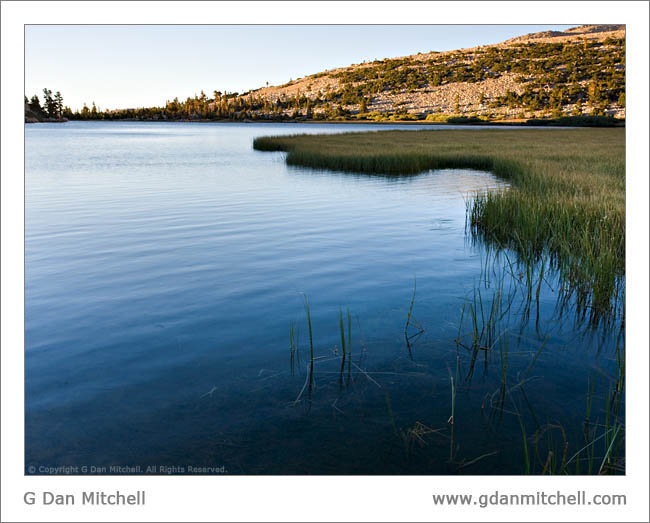
Morning, Long Lake. Sierra Nevada, California. August 6, 2007. © Copyright G Dan Mitchell.
The next morning we arose to begin the climb over New Army Pass. Being the second-slowest person in the group (hey, almost everyone else is half my age!) I got started early, second, and way before the younger members of the party. The climb to the pass begins immediately at the lake as the trail leaves the lakeside meadows and trees and cuts directly up into the rocky terrain above. A winding path leads eventually to a flat area where the trail crosses some water, and from here the trail switchbacks continuously to the pass. Compared to the rough, unmaintained Old Army Pass, New Army is a marvel of trail engineering. It is well graded and well constructed; in fact, I’d say that it is by far the easiest 12,000’+ Sierra Pass I’ve ever climbed. Eventually, after many long traverses, the trail winds a bit to the right and up via shorter switchback sections and reaches the broad, flat summit of the pass.
It was windy on the summit, and as the members of our group arrived they collected in a sheltered area behind some rocks to grab a snack and relax after the climb. As energy returned, we took a better look at our surroundings. The view, not surprisingly, opens up tremendously at the pass. Looking east, the string of lakes we passed during the previous 24 hours could be seen, with Owens Valley and in the far distance desert peaks visible through the haze. (I’m fairly certain that I was able to spot Telescope Peak, high in the Panamint Range of Death Valley.)
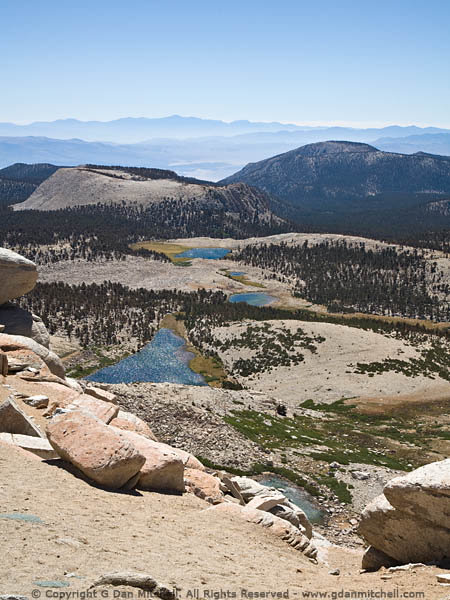
Looking East from New Army Pass. Sierra Nevada, California. August 6, 2007. © Copyright G Dan Mitchell.
The ridge itself is quite flat, and it was easy to walk either way along its length.
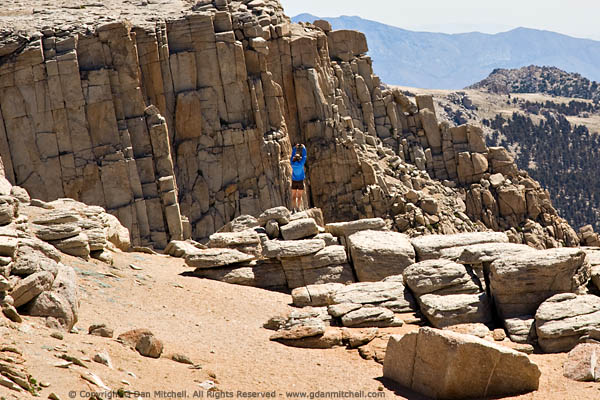
Summit Ridge Near New Army Pass. Sierra Nevada, California. August 6, 2007. © Copyright G Dan Mitchell.
Below, over a very easy slope, we could see the point where Old Army Pass emerges from the gully onto the low point on the ridge between New Army Pass and the Mt. Langley massif, with the tip of Mt. Whitney just visible beyond. Far to the west is the Great Western Divide and (I’m pretty certain) the area around Franklin Pass. All of the terrain visible from here is very high and alpine – virtually no trees are visible at all.
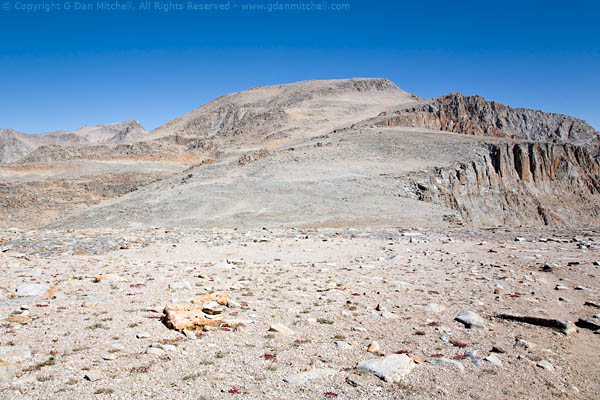
Mt. Langley, From New Army Pass. Sierra Nevada, California. August 6, 2007. © Copyright G Dan Mitchell.
Finished with our rest and snack break, we started down from the pass. The first section descends over smooth, open terrain towards the low area between New Army Pass and the ridge’s rise toward Mount Langley. (The “trails” to Langley are clearly visible from this area.) Our trail paralleled the Old Army trail for some distance, though they are quite close together – eventually they merged. Before long the trail began to drop quite steeply into a valley heading toward lower terrain west of the pass. It would be a lot more work coming up this trail than it was descending.
Our plan was to head toward Miter Basin and Blue Sky Lake, where we would camp for the night in preparation for crossing Crabtree Pass the following day. Since one member of our party planned to leave our group at Soldier Lake (and return to Horseshoe Meadow via Old Army Pass and Cottonwood Lakes), we took the turnoff to that location rather than continuing on down canyon to the stream emerging from Miter Basin. This seems to be another popular destination, and there appeared to be quite a few parties camped there. After lunch we left him to set up his camp and then walked a bit further along the left side of the lake.
Eventually we came to a steep break in the cliffs which afforded a way to the top of the ridge and then into Miter Basin. At the top of this short but quite steep climb (along a route that is obviously used frequently) we came to the top of the ridge and could look down into the Miter Basin drainage where the “normal” route ascends from the left. Rather than dropping into the basin and then having to regain our elevation, we contoured to the right across easy terrain of open forest and rocky slabs until we finally met the creek a good distance up the canyon. Here we picked up an unmarked trail that took us up the canyon, joining the use trail well below the point where the steep final climb to Blue Sky Lake begins.
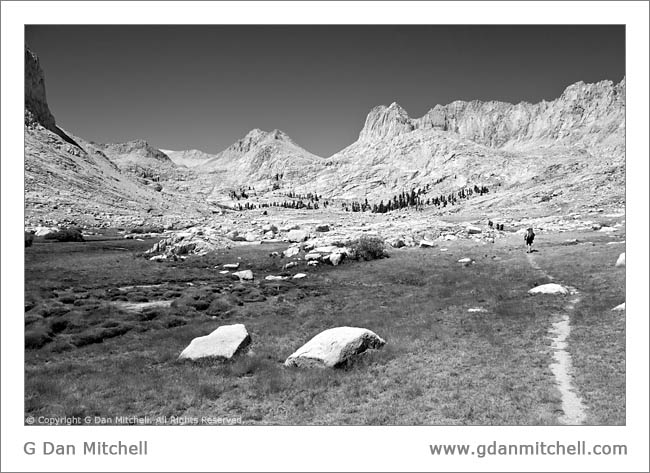
Entering Miter Basin Below Blue Sky Lake. Sierra Nevada, California. August 6, 2007. © Copyright G Dan Mitchell.
Though it was obvious where we had to end up, the best way to get there was not always obvious as we climbed this rocky section of the route. We finally emerged just to the left of the outlet stream, only to realize that we really needed to be on the right bank, beyond which there were a number of campsite possibilities. We quickly negotiated this crossing, passed by another party camped on the high point here, and found our own campsite above the lake behind a sheltering cliff wall.
We could see the general outlines of the route we would follow the next day on our ascent to class 2 Crabtree Pass, though the actual pass is not visible from Blue Sky Lake. It was clear that the route would ascend alongside the creek on the far side of the lake, passing a large rock bench to the left before working around to the right towards the pass. But tomorrow’s adventure is a story for another post…
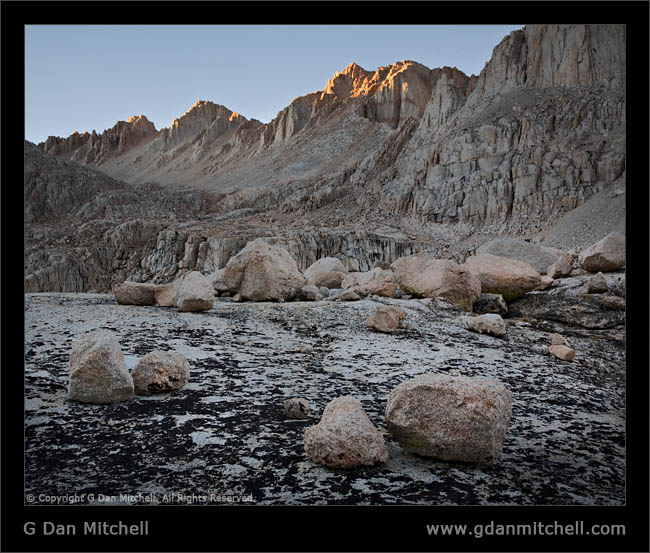
Last Light, Miter Basin. Sierra Nevada, California. August 6, 2007. © Copyright G Dan Mitchell.
More on 4WheelBob's White Mountain Hike
Thanks to Tom Mangan’s participation as a member of the Bob’s support crew, the San Jose Mercury News was able to put together a nice story about 4WheelBob’s hike to the top of 14,000’+ White Mountain. Tom’s links are below:
- Mercury News profiles 4WheelBob
- Mike Cassidy talked to Bob this week and the story ended up on today’s front page.
- Tom’s sidebar. Summation: it never felt so good to be proved wrong.
An excerpt from the second link:
Coomber, 52, who lives in Livermore, is not one for the overly dramatic. As we talked in the office building where he works for Wells Fargo’s auto financing division, Coomber explained that he wasn’t out to make some profound statement about overcoming adversity.
“To me,” he said, “it’s just doing what I do.”
And that is quite a statement, in my view.
Electrical Storms… In the San Francisco Bay Area?
As if on cue to reinforce my previous post’s observation about California’s dry weather year, the Weather Service is now predicting a very-unusual-around-these-parts chance of thunderstorms over the Central California coast today. From an article in SFGate:
Tropical moisture wandering up from Central California is predicted to make its way into the South Bay and East Bay this afternoon, producing a chance of thunderstorms over higher terrain, the weather service said…
In addition to the possible thunderstorm, the Bay Area and Northern California will be awash in red flag warnings, electricity alerts, fire weather watches and heat advisories.
Perhaps the greatest danger from the thunderstorms is the possibility that dry lightning could spark fires, given that inland temperatures are expected to approach 100 degrees again today. A red flag warning was posted for Monterey County.
Such weather is not unheard of in the late summer around here, but it isn’t the typical pattern. The problem – as mentioned in the article – is that frequently the lightning is not accompanied by any significant rain, so instead of relieving some of the dryness these storms more often set off fires. It is fire season between now and late October in California, and it is an exceptionally dry year.
A Good – But Really, Really Bad – Web Site for Fire Conditions
Tom Mangan reports at Two-Heel Drive:
Fire news blog. California Fire News could use a visual-appeal consultant, but the content’s there. Has tons of news headlines and weather reports (still in all-caps, the way the National Weather Service likes it). [Two-Heel Drive]
Content, yes. Visual (and aural!) appeal? GACK!
The text doesn’t line up and some of it covers other text. The visual across the top of the page is… well, I’m at a loss for words. And then the audio comes on…
… A recording of a chainsaw! Sheesh!
But I bookmarked the site. It has a ton of information about fire conditions and related topics in California, and something tells me that this may be a critical concern between now and the end of October, what with historic drought in parts of the state right now.
I’ll just need to remember to turn the sound off when I visit the site…
Chronicle Outdoors Writer Paul McHugh Moves On
San Francisco (and SFGate) outdoors writer Paul McHugh is moving on to other adventures:
California’s great outdoors still will be around after Saturday. But I won’t. Well, not at this particular newspaper, I mean. After 22 years of pounding the outdoors beat for The Chronicle – and sometimes getting pounded by it – I’m about to fold my tent and take a hike. And yes, I do mean that literally.
And…
For me now, as the song says, the time has come to say sayonara. Not farewell to writing on these topics about which I care so much, no sir, no way. And not farewell to many other forms of work. Only, to practicing the craft at this particular venue. I plan to devote myself to larger projects, those grand pieces of artistry I’ve always lusted after, but never found enough time to address very well – you know, novels, plays, poetry. I’ve got a satchel full of pocket notebooks dating back to the teen years, and it’s getting on toward high time to crack ’em open and energize their contents.
I’ve enjoyed subscribing to his RSS feed from SFGate and reading his articles Good luck to Paul!
Subscribe

-
Archives
- April 2012 (1)
- January 2011 (1)
- September 2010 (2)
- August 2010 (1)
- July 2010 (4)
- June 2010 (6)
- May 2010 (11)
- April 2010 (4)
- March 2010 (1)
- February 2010 (1)
- January 2010 (5)
- October 2009 (4)
-
Categories
- Abstract
- Black and White
- Castle Rock
- Commentary
- Death Valley
- Desert
- Environment
- Equipment
- Events
- Gear Reviews
- Green World
- History
- Mission Peak
- Mono Lake
- Mount Shasta Area
- News
- Ocean
- Owens Valley
- Pacific Northwest
- People
- Photography
- Places
- Point Lobos
- Quicksilver
- Quicksilver Historical
- Quotable
- Random
- San Francisco Bay Area
- Santa Teresa
- Sierra Nevada
- Site News
- Technique
- Trails
- Trips
- Uncategorized
- White Mountains
- Wildlife
- Yosemite
-
RSS
Entries RSS
Comments RSS
 Dan's Outside
Here We Go: California's Fire Season
The sight of huge towers of smoke from the Lick Fire at Henry Coe Park last night reminded me again that the next two months could be a terrible fire season in California. (According to this morning’s reports, the fire has ballooned to over 5,000 acres in less than 24 hours as it burns through drier-than-usual grassland, chaparral, and forest between Mt. Sizer and the Mount Hamilton area.)
September and October are heart of the wildfire season in most of California. By this time of year, there generally has not been appreciably rain in five or six months. In addition, this is that time of the “off-shore” winds that come from the northeast, supplying continental heat, drying as they move downslope, and fanning any fire that does start. The smell of smoke from fires near or far is never far away in the Sierra this time of year.
And this year many parts of California are suffering from an extraordinarily dry winter season. In the Sierra, last season’s precipitation ranged from about 50% of normal in the northern Sierra down to about 20% of normal in the south. The effects of the former are obvious to regular visitors to the mountains, but the effects of the latter are quite stunning. I spent about a week backpacking in the southern Sierra in early August and I have never seen conditions like this year’s so early in the season – early August conditions looked more like mid- September, with almost all high altitude vegetation having gone brown already.
The fact that there is a fire in the Coe Park backcountry is not the big news. It is natural for these hills to burn from time to time, especially during this season. What is surprising to me is the incredible speed with which this fire spread during its first day.
(Note: Tom Mangan has included an impressive aerial photograph of the fire shot last night in a post at his blog.)
Share this:
September 4, 2007 Posted by gdanmitchell | Commentary, Environment | Comments Off on Here We Go: California's Fire Season