Sunset at Point Reyes
The last photo of the day from yesterday’s visit to Point Reyes National Seashore.
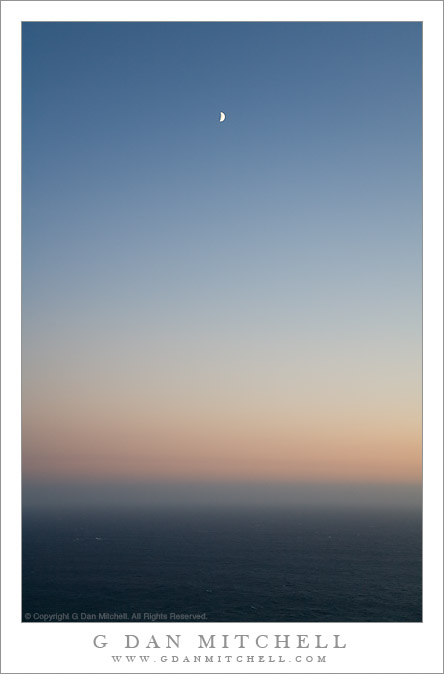
September Moon, Pacific Sunset. Point Reyes National Seashore, California. September 18, 2007. © Copyright G Dan Mitchell.
You’d never know it from this peaceful image, but the wind was blowing so hard I could barely stand up straight!
Tom Goes to Point Lobos
So soon after my visit that we might have almost passed on highway 1, Tom Mangan also visited Point Lobos. Sounds like we’re on to something with the September visits to this park.
As for me, continuing my theme of visiting the shoreline, yesterday I spent a day at Point Reyes National Seashore. More on this soon, but a few comments now.
I’m almost embarrassed to say that this was actually my first visit to this Bay Area treasure. I’ve driven past the park before, but that’s it.
Doing a one-day up-and-back trip from the south SF Bay meant that I was up at 5:00, on the road shortly after that, and didn’t return until about 10:30 p.m.
For me at least, the appeal of this park is different than that of my beloved Sierra Nevada. Perhaps that is partly because the terrain and the flora are not so different from the hills around my home. But there are some places there that do get my attention. I hiked out to Arch Rock and sat there for alone for awhile. I visited the north shore on my way to Point Reyes itself, and the surf is astounding on these beaches facing the open Pacific to the north. At Point Reyes near the lighthouse at sunset, the wind was wild and the sky was spectacular.
Breakfast on the Trail
After seeing this morning’s Trailcraft post about breakfast I thought I’d offer my thoughts about breakfast on the trail.
For years I’ve valued simplicity above fanciness when it comes to trail meals, and breakfast is no exception. I’m generally uninterested in spending a lot of trail time preparing food. My standard breakfast has long been cold granola, perhaps supplemented by a cup of tea. I pick up granola in the bulk food bin at my local Whole Foods and re-bag it for the trail. To a single serving (maybe about 2/3 to 3/4 cup) of granola I add a heaping tablespoon of dry milk power. Since it can be hard to get dry milk to fully dissolve on the trail, I shake the sealed ziploc bag containing milk powder and granola until everything is evenly distributed. Fixing breakfast couldn’t be easier: Find a comfortable rock with a great view, sit, empty bag into cup/bowl, add water, mix a bit, and eat. (I’ve speculated that it might work to pour the water straight into the ziploc, seal, mix, and eat from the bag – but the thought of carrying milk and granola coated plastic bags in my trash bag has dissuaded me from trying this.)
On long pack trips careful food selection and packing become all the more important. On a short trip it isn’t a problem if you over- or under-pack a bit, but both are to be avoided on a long trip. You don’t want to carry any more food than necessary, but you sure as heck don’t want to run short. In addition, these days you have to think of how you’ll cram it all into a bearproof canister. A few years ago, while preparing for a long Sierra pack trip, it occurred to me that a meal of granola is probably slightly larger than a meal of oatmeal, with the downside that preparing oatmeal consumes fuel. However, if you are approaching the capacity limit of your bear canister, adding fuel bulk outside of the canister to extend the number of days worth of food you can fit in the canister can be a Good Thing. (I can get more than 10 days of food into a standard canister and I’ve been out for a week using only the small Bearvault.)
As a consequence of this slightly convoluted reasoning I often replace the granola with oatmeal on longer trips. While each ziploc of oatmeal is only a bit smaller than a ziploc of granola, on a long trip the difference probably adds up to at least on extra breakfast. I assemble my own “trail oatmeal” at home, again using ingredients from the grocery store bulk bins. I start with 1/2 cup of “quick cooking” (not instant!) oatmeal, to which I add some raisins (or perhaps date or apple pieces), a few chopped nuts (walnuts or perhaps almonds), some brown sugar, dry milk powder, and cinnamon. The whole thing cooks on low heat in three minutes or less on the trail, and I’ve come to look forward to the hot breakfast. If I’m going to have tea (see below) I start out by boiling enough water for both tea and oatmeal. After pouring out the water for the tea I add the oatmeal ingredients to the simmering water, and I drink tea while fixing oatmeal.
What about beverages? Many years ago I used hot chocolate mixes (e.g. “Swiss Miss”) and even carried Tang, the industrial strength pseudo-orange-juice powder. Yuck! The chocolate mixes are too bulky and heavy, and don’t really taste all that great. Tang is, well… Tang. Let’s not go there. For a short time I carried a very small single-cup espresso maker – wonderful coffee, finicky operation, too much weight. These days I only carry a few tea bags. They are small and light and even a confirmed coffee addict like me can learn to like tea on the trail – in truth, I don’t miss espresso at all on the trail now. I usually carry a few herbal mint teas (especially good in the evening) along with some stronger caffeinated teas for breakfast.
Sunset at Point Lobos State Reserve
Point Lobos State Reserve (part of the California State Parks System) is one of the best places in central California to enjoy the Pacific coast. This rocky shoreline features great vistas and wildlife including otters, sea lions and seals, and tons of birds. There have been two downsides:Being only a few miles south of the tourist mecca of Carmel it can be quite crowded, and closing time has always been way before sunset – at one of the best places in the state to watch the sun set over the Pacific.
This summer the park system fixed one of those problems, and in doing so reduced the other. The change is that the park now closes 30 minutes after sunset. (This may change after the peak tourist season, so contact the park to make sure that this policy is still in effect before visiting.) Yesterday I went there to photograph the evening light – the park listed sunset as 7:15 so I was able to stay until nearly 7:45.
It was a nearly completely calm evening, with low surf and almost no wind. The “golden hour” light was beautiful, occasionally illuminating wispy clouds of fog.
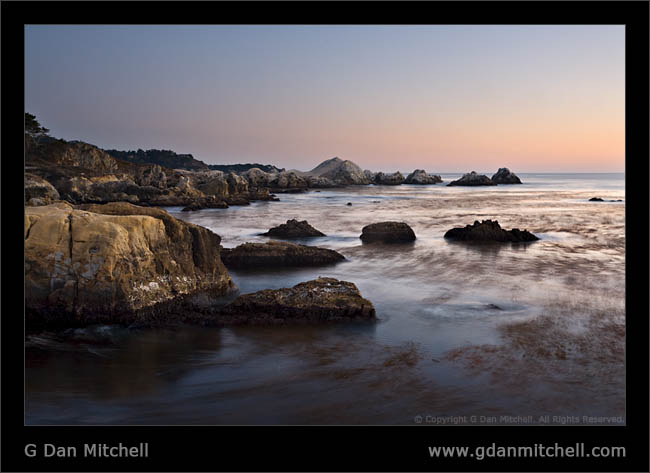
Dusk, Point Lobos State Reserve. Monterey Peninsula, California. September 15, 2007. © Copyright G Dan Mitchell.
Surprisingly, there was almost no one in the park at this most beautiful time of day – quite a contrast with a typical weekend during the day, when the park can be so full that all the parking spaces are taken and cars are queued up at the entrance waiting to get in. There seemed to be a small number of people waiting for the sunset, but most of them left around 7:15 as the sun dropped below the horizon. Extraordinary light continued, and perhaps even improved, for another 20 minutes or so – but I don’t think that there could have been more than a dozen people left by then.
Lower Young Lake, Morning
As an example of why it was so hard to get on the trail on the last day of my recent Young Lakes pack trip, this photo of a morning view a short stroll from my campsite.
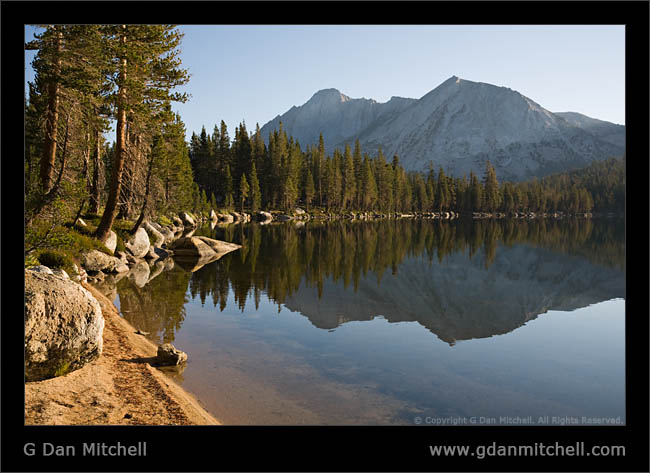
Lower Young Lake, Morning. Yosemite National Park, California. September 11, 2007. © Copyright G Dan Mitchell.
Sierra Nevada and Yosemite backcountry aficionados may recognize the taller peak to the left as Mt. Conness.
Wildfire Photographs
From Firefighter Blog:
Desiree’s Zaca Fire Photo Array. If you follow this blog regularly you know I am a huge fan of Copter Chick Desiree Horton. As you may know Desiree and her crew spent many weeks on the Zaca Fire. Click here to view her unbelievable images of the Zaca Fire from the air. By Mike. [Firefighter Blog]
If you want to see some very interesting photographs of California wild fires (and some aspects of how they are fought) take a look at this link.
A Cross-country Route: Young Lakes to the Dog Lake Trail
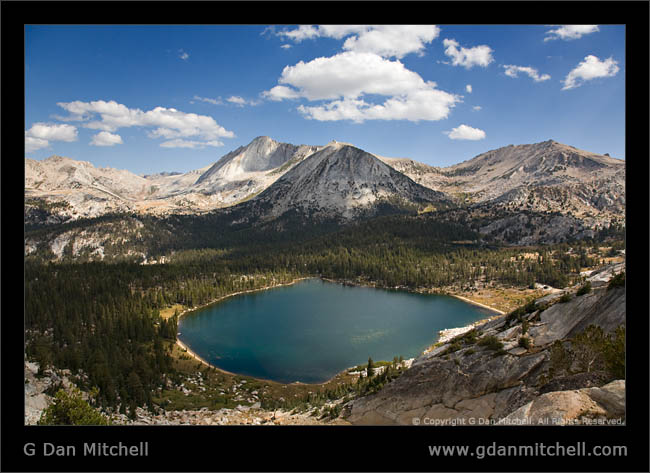
Lower Young Lake, Mount Conness. Yosemite National Park, California. September 11, 2007. © Copyright G Dan Mitchell.
I have hiked the well-travelled path from Tuolumne Meadows past Dog Lake to Young Lakes several times. Every time I’ve crossed Dingley Creek, about 3.5 miles out on this trail, I’ve thought of two things: that the view of the Cathedral Range from here is one of the most astonishing vistas in Yosemite, and that it would be interesting to explore the open basin of Dingley Creek above the trail. On this past week’s short pack trip I got my chance.
For now I’ll skip over the first two days of the trip, saying only that I hiked, I camped, I photographed, I got rained on, and it was a good trip. On day two, I spent some time shooting the breeze with a ranger who was on patrol in the area and, among other things, he mentioned that there was a shortcut back toward the Dog Lake Trail. He confirmed what I had read elsewhere and suspected from looking at my surroundings: there is a nice little route over the saddle just to the left of Ragged Peak (as viewed from Lower Young Lake) that ends up rather high in the Dingley Creek drainage and which cuts a perhaps as much as a mile off of the hike. But that’s not the main attraction – the scenery on this short alpine route is much more exhilarating than that on the regular trail. So, on the morning of the final day of my little trip I decided to forego the trail and instead check out this alternate route.
As is the case with many Sierra Nevada cross-country routes there are many possible “right” paths to follow, and many of them are clear from the traces of earlier hikers – and both were the case on this route. I began by heading up through the lakeside forest into the rocky area below Ragged Peak, and generally angling up and to the left as I ascended. I kept quite close to the side of Ragged Peak, and soon found that there was a faint trail – at least in places – where others had gone before. It was easy climbing and route finding for the most part, and I encountered only one slightly dicey section. The steepest portion is on the first half of the climb or so; after that I arrived at a more level area with large boulders backed by a flat, sandy area that could have been a tarn if the water didn’t naturally drain away here. (The photo above was taken from more or less this spot.)
From here the approach to the saddle was very obvious, and I crossed the base of this last slope to the left before ascending on rocky, sandy terrain to the top. The saddle was broad and fairly level with the very gentle slope descending in front of me along the base of the ridge before turning left and heading into the main basin of Dingley Creek. Through this section there was a fairly obvious trail, at least until the route descended through meadow and open forest towards the flatter section of the valley. At the bottom of this slope I angled ahead and right, planning to intersect with the main trail closer to the far side of the shallow valley.
If you like a bit of cross-country travel and are in the area, this is a route that is well-worth the effort. Sometime I’d like to go back this way and bivy in upper Dingley Creek Basin – I think there are some real opportunities for great photographs of the Cathedral Range from this area.
Panel Faults Emphasis of U.S. Climate Program
From a New York Times article:
An effort by the Bush administration to improve federal climate research has answered some questions but lacks a focus on impacts of changing conditions and informing those who would be most affected, a panel of experts has found.
The Climate Change Science Program, created in 2002 by President Bush to improve climate research across 13 government agencies, has also been hampered by governmental policies that have grounded earth-observing satellites and dismantled programs to monitor environmental conditions on earth, concluded the report, issued by the National Academies, the nation’s pre-eminent scientific advisory group.
No surprises here…
Sierra Weather: What Was I Thinking?
I’m just back from a nice little near-the-end-of-the-season pack trip out of Tuolumne Meadows – I spent a couple nights out in the Young Lakes basin. I’ll probably write a bit more about the trip and post some photos later, but for now here’s a little story about me and the weather.
I often follow Sierra weather forecasts even when I’m not going to the mountains, but before a pack trip I often consult several sources before I leave, including the Weather Service forecast discussions. By wading though the somewhat technical verbiage and reading between the lines I can often pick up important hints that may affect my choice of destination and – more often – what gear I take.
This past Saturday and again on Sunday morning before I left, the basic thread was that we were going into a fairly benign weather week, with some cloudiness around the Sierra crest on Sunday and then a clearing trend. So I decided to leave my tent at home and take only my bivy, even leaving my small Siltarp in the car to minimize weight.
The short story is that I got the chance to find out what it is like to camp in a bivy in the rain. The longer story follows, and includes a little lesson on what happens when I focus too much on weather reports… and perhaps not enough on the actual weather.
Nothing too surprising happened on Sunday, the first day of my little trip. I knew that there would be some clouds in the afternoon – as a photographer I actually looked forward to this bit of interesting weather – and a slight possibility of some showers. So I wasn’t at all surprised when the clouds thickened and it started to sprinkle a bit by the time I was a mile or so from my camp at Lower Young Lake. This was very minor weather – the sort where you put the pack cover on “just in case it really starts to rain,” and keep the rest of the rain gear near the top of the pack. The sprinkles pretty much passed by the time I set up camp.
The morning was beautiful on day two with blue sky (though hazy, perhaps from those September California fires) and a stray cloud or two. I decided to wander on up past Middle and Upper Young Lakes, and perhaps continue on up to a further lake along the route to Mt. Conness, or possibly travel to nearby Roosevelt Lake. In light of the generally nice weather and bearing in mind the forecast of fair weather I had read before leaving, I chose to travel light, carrying only camera gear and some water – I carried no rain gear or other clothing beyond what I wore.
As I walked the short distance to the two upper lakes I was a bit disappointed in the flat light under increasingly cloudy conditions. Oddly, having that weather forecast so fixed in my mind, I didn’t really even consider that it might rain – in conditions that would have caused me to think about this in normal circumstances. After photographing at the upper lake I thought I’d wander up to a point on a low ridge where I could either continue to the upper lake or head over toward Roosevelt. It was here that I first heard thunder and then felt a few rain drops. I thought something like, “That’s odd. It shouldn’t rain today,” but I decided that it might be a good idea to reconsider my plans and head back toward the lower lake.
A couple minutes later it was raining enough that I had to stop and put a rain cover on my camera bag. As I dropped through a steeper section of the route between the middle and upper lake I realized that I was starting to get significantly wet. I found a partially fallen tree that provided shelter until the rain slacked off a bit, and then continued on for another 15-20 minutes in the drizzle to reach my campsite.
Fortunately, I had zipped my bivy up tight, so my camp was secure and dry. Now I had the opportunity to figure out how to try to keep it that way while getting out of wet clothes and into the bivy. It went something like this: Take boots off and stuff them into a large plastic bag along with pack and few other odds and ends. Move food canister close to bivy in case rain continues during dinner. Open bivy and push sleeping bag away from the opening. Standing in the opening of the bivy, quickly put on additional poly layers and put the damp pants and shirt on over them. Zip into the bivy while lying on top of the sleeping bag and let body heat do its work of drying the damp clothes. Listen to thunder and rain and hail on the bivy. When rain stops, sit up in bivy and fix dinner… and then zip up again for after-dinner showers.
It finally stopped and, yes, a bivy is a decent though cramped shelter in light rain. (Remember to bring a book…)
A lesson learned: Next time pay a whole lot less attention to what the weather is supposed to be and a lot more attention to what it actually is doing.
Subscribe

-
Archives
- April 2012 (1)
- January 2011 (1)
- September 2010 (2)
- August 2010 (1)
- July 2010 (4)
- June 2010 (6)
- May 2010 (11)
- April 2010 (4)
- March 2010 (1)
- February 2010 (1)
- January 2010 (5)
- October 2009 (4)
-
Categories
- Abstract
- Black and White
- Castle Rock
- Commentary
- Death Valley
- Desert
- Environment
- Equipment
- Events
- Gear Reviews
- Green World
- History
- Mission Peak
- Mono Lake
- Mount Shasta Area
- News
- Ocean
- Owens Valley
- Pacific Northwest
- People
- Photography
- Places
- Point Lobos
- Quicksilver
- Quicksilver Historical
- Quotable
- Random
- San Francisco Bay Area
- Santa Teresa
- Sierra Nevada
- Site News
- Technique
- Trails
- Trips
- Uncategorized
- White Mountains
- Wildlife
- Yosemite
-
RSS
Entries RSS
Comments RSS
 Dan's Outside
Wow, That's Early!
West Coast Imaging’s blog reports that there is snow on Tioga Pass, and backs up the claim with photographic evidence. In the long run, who knows what it means – it could easily turn warm again, as it often does in late September and early October. But still, kinda’ gets the winter juices going, doesn’t it?
Share this:
September 20, 2007 Posted by gdanmitchell | Commentary, Places, Yosemite | Comments Off on Wow, That's Early!