Back From Visiting the Aspens

Sierra Aspen Grove, Sun. Sierra Nevada, California. September 29, 2007. © Copyright G Dan Mitchell.
I’ll write more about my adventure later…
Talusdancers Trip: Another Report
Owen, my good friend and fellow talusdancer has posted his account of our August week-long pack trip from Horseshoe Meadow to Symmes Creek via New Army Pass, Crabtree Pass, and Shepherd Pass. Among other interesting things, it includes something I cannot often provide at this web site – photographs of me backpacking! :-)
Crossing New Army Pass
Last week I began recounting some of my Summer 2007 backpacking experiences with a description of Crossing Shepherd Pass. Here I’ll continue with another pass from the same trip, New Army Pass.
First a bit of background. A few years ago, a previous talusdancers trip took us into the same area. We began that trip at the very same trailhead (at Horseshoe Meadow, south of Mt. Whitney in the eastern Sierra) and then diverged into the Cottonwood Lakes Basin. We spent several days there, and the highlight of the trip was ascending Old Army Pass to summit Mt. Langley, the southernmost 14’er in the Sierra. At the top of Old Army Pass the trail arrives at the summit plateau, and I was able to see hikers coming in over nearby and slightly higher New Army Pass.
This year’s early-August talusdancers trip was a large week-long route starting south of Mt. Whitney at Horseshoe Meadow, crossing New Army and Crabtree Passes to get get to Crabtree Meadow west of Whitney, and then heading north on the John Muir Trail (JMT) via Wallace, Wright, and Tyndall Creeks, and finally exiting east to Owens Valley via Shepherd Pass. Much of the central portion of this trip in the Kern River drainage is familiar to me from several previous trips, but I never tire of the spectacular scenery in this part of the Sierra.

Talusdancers at the Horseshoe Meadow Trailhead. Sierra Nevada, California. August 5, 2007. © Copyright G Dan Mitchell.
On our first day (August 5, 2007) we headed up the familiar (to some of us, at least) trail out of Horseshoe Meadow. This is a very high trailhead, starting at around 10,000 feet – though the far-southern Sierra location makes it seem a bit less alpine than north Sierra backpackers might expect. The first part of the trail is quite easy walking with some descent into the Cottonwood Creek drainage before a mostly-easy climb toward Cottonwood Lakes. (The only remotely steep section on this trail is the descent of what seems to be an old moraine just before the junction to the Cottonwood Lakes.)
Our initial plan had been to camp at one of the upper Cottonwood Lakes (Lake 5, if memory serves) near the start of the trail up Old Army Pass, which we would climb on the second day. As we thought more about this we began to consider the alternative of going over New Army Pass instead. We knew from previous trips that the Old Army Pass is not really maintained any more, plus none of us had ever seen the summit of New Army Pass. The latter was the deciding factor – why do the “same old” when something new is available? – and we changed out plans accordingly, taking the left turn toward New Army at the first Cottonwood Lake.
The easy hiking continued as the trail gradually ascended toward our goal of Long Lake, at the base of New Army Pass. One notable spot along this trail is an astonishing jumble of glacial boulders filling a huge, relatively flat area between Cottonwood Lake #1 and the lakes closer to the pass. Fortunately, the trail skirts around this very difficult looking terrain, but remains close enough to get a good look at it.
We finally arrived at pretty Long Lake, with Cirque Peak and the walls at the upper end of the canyon towering above – we left the trail to walk to the lake at just the point where the real ascent to the pass begins, and we strolled through lakeside trees and meadows (and quite a few other occupied campsites) to get to our spot a bit further from the trail.
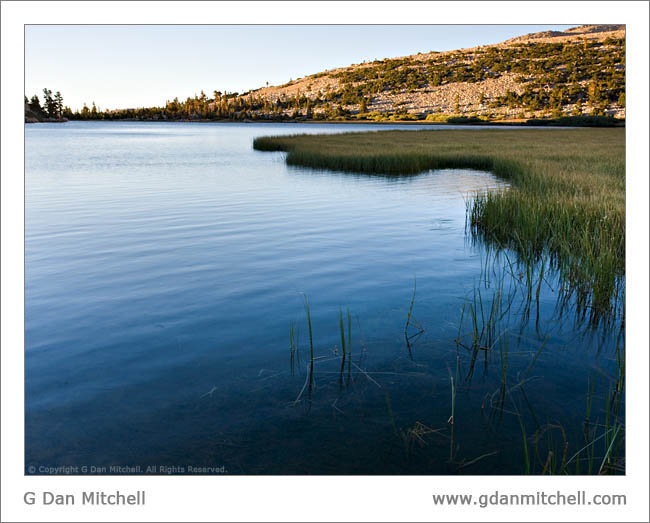
Morning, Long Lake. Sierra Nevada, California. August 6, 2007. © Copyright G Dan Mitchell.
The next morning we arose to begin the climb over New Army Pass. Being the second-slowest person in the group (hey, almost everyone else is half my age!) I got started early, second, and way before the younger members of the party. The climb to the pass begins immediately at the lake as the trail leaves the lakeside meadows and trees and cuts directly up into the rocky terrain above. A winding path leads eventually to a flat area where the trail crosses some water, and from here the trail switchbacks continuously to the pass. Compared to the rough, unmaintained Old Army Pass, New Army is a marvel of trail engineering. It is well graded and well constructed; in fact, I’d say that it is by far the easiest 12,000’+ Sierra Pass I’ve ever climbed. Eventually, after many long traverses, the trail winds a bit to the right and up via shorter switchback sections and reaches the broad, flat summit of the pass.
It was windy on the summit, and as the members of our group arrived they collected in a sheltered area behind some rocks to grab a snack and relax after the climb. As energy returned, we took a better look at our surroundings. The view, not surprisingly, opens up tremendously at the pass. Looking east, the string of lakes we passed during the previous 24 hours could be seen, with Owens Valley and in the far distance desert peaks visible through the haze. (I’m fairly certain that I was able to spot Telescope Peak, high in the Panamint Range of Death Valley.)
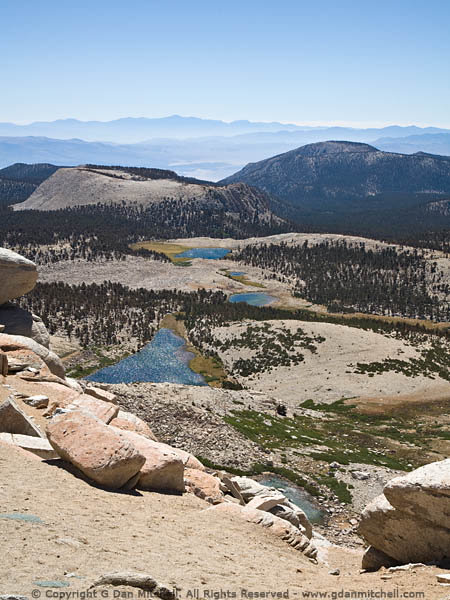
Looking East from New Army Pass. Sierra Nevada, California. August 6, 2007. © Copyright G Dan Mitchell.
The ridge itself is quite flat, and it was easy to walk either way along its length.
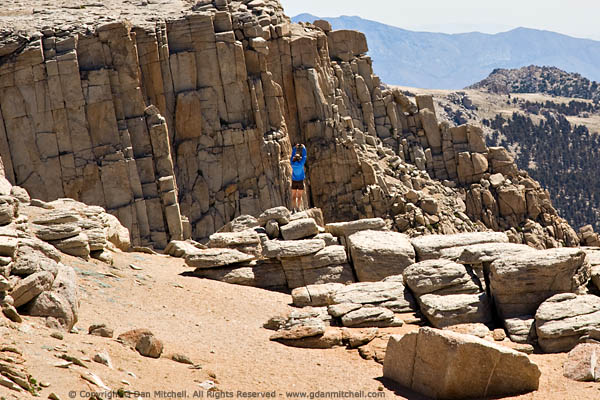
Summit Ridge Near New Army Pass. Sierra Nevada, California. August 6, 2007. © Copyright G Dan Mitchell.
Below, over a very easy slope, we could see the point where Old Army Pass emerges from the gully onto the low point on the ridge between New Army Pass and the Mt. Langley massif, with the tip of Mt. Whitney just visible beyond. Far to the west is the Great Western Divide and (I’m pretty certain) the area around Franklin Pass. All of the terrain visible from here is very high and alpine – virtually no trees are visible at all.
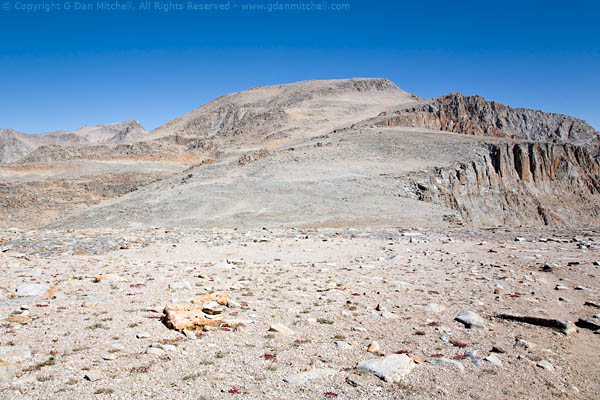
Mt. Langley, From New Army Pass. Sierra Nevada, California. August 6, 2007. © Copyright G Dan Mitchell.
Finished with our rest and snack break, we started down from the pass. The first section descends over smooth, open terrain towards the low area between New Army Pass and the ridge’s rise toward Mount Langley. (The “trails” to Langley are clearly visible from this area.) Our trail paralleled the Old Army trail for some distance, though they are quite close together – eventually they merged. Before long the trail began to drop quite steeply into a valley heading toward lower terrain west of the pass. It would be a lot more work coming up this trail than it was descending.
Our plan was to head toward Miter Basin and Blue Sky Lake, where we would camp for the night in preparation for crossing Crabtree Pass the following day. Since one member of our party planned to leave our group at Soldier Lake (and return to Horseshoe Meadow via Old Army Pass and Cottonwood Lakes), we took the turnoff to that location rather than continuing on down canyon to the stream emerging from Miter Basin. This seems to be another popular destination, and there appeared to be quite a few parties camped there. After lunch we left him to set up his camp and then walked a bit further along the left side of the lake.
Eventually we came to a steep break in the cliffs which afforded a way to the top of the ridge and then into Miter Basin. At the top of this short but quite steep climb (along a route that is obviously used frequently) we came to the top of the ridge and could look down into the Miter Basin drainage where the “normal” route ascends from the left. Rather than dropping into the basin and then having to regain our elevation, we contoured to the right across easy terrain of open forest and rocky slabs until we finally met the creek a good distance up the canyon. Here we picked up an unmarked trail that took us up the canyon, joining the use trail well below the point where the steep final climb to Blue Sky Lake begins.
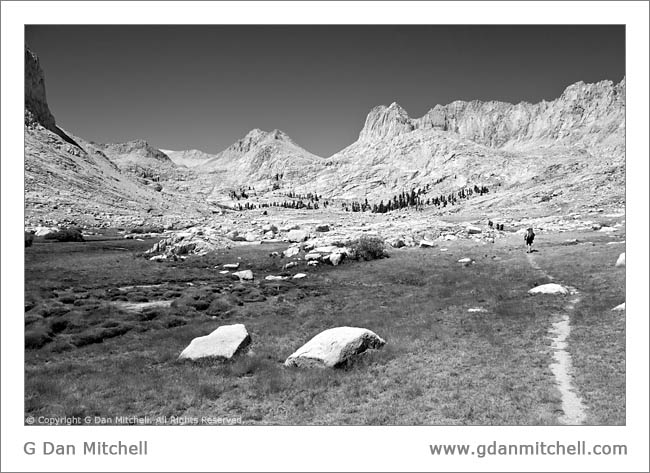
Entering Miter Basin Below Blue Sky Lake. Sierra Nevada, California. August 6, 2007. © Copyright G Dan Mitchell.
Though it was obvious where we had to end up, the best way to get there was not always obvious as we climbed this rocky section of the route. We finally emerged just to the left of the outlet stream, only to realize that we really needed to be on the right bank, beyond which there were a number of campsite possibilities. We quickly negotiated this crossing, passed by another party camped on the high point here, and found our own campsite above the lake behind a sheltering cliff wall.
We could see the general outlines of the route we would follow the next day on our ascent to class 2 Crabtree Pass, though the actual pass is not visible from Blue Sky Lake. It was clear that the route would ascend alongside the creek on the far side of the lake, passing a large rock bench to the left before working around to the right towards the pass. But tomorrow’s adventure is a story for another post…
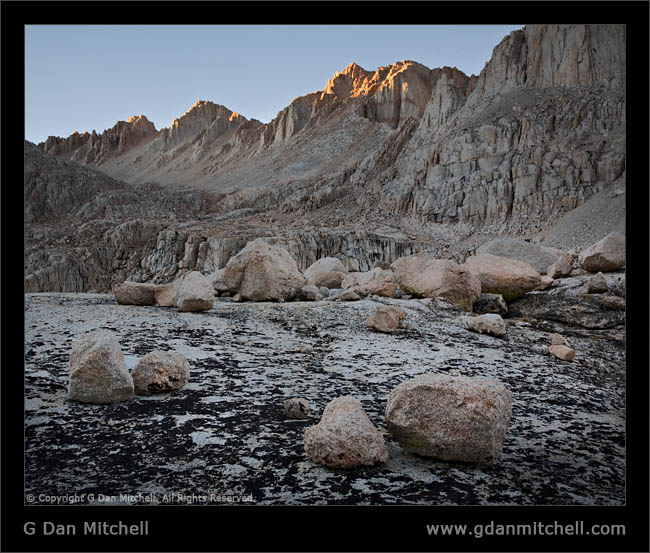
Last Light, Miter Basin. Sierra Nevada, California. August 6, 2007. © Copyright G Dan Mitchell.
Crossing Shepherd Pass
For nearly two weeks now I’ve been meaning to start writing up the two longish Sierra Nevada pack trips I took earlier this summer, but life and the major task of describing two weeks of trail travel and putting together the photos have held me back. Rather than continuing to wait, I’ve decided to start with some shorter posts covering sections of the trips. This description of crossing Shepherd Pass is the first.
The second week-long pack trip, with the talusdancers gang, began on August 5 at Horseshoe Meadow in the eastern Sierra south of Mount Whitney. Basically we skirted the Whitney area to the west, coming over New Army and Crabtree Passes (the latter definitely being worthy of an upcoming post) and then heading north on the John Muir Trail (JMT) to Tyndall Creek where we headed east to exit the mountains.
This exit was via Shepherd Pass. I’ve read about this pass for years, and I know that it has a reputation as one of the most difficult trails across the Sierra Crest. Some people say it ties with Baxter Pass (which I’ve also crossed) for the title of second worst pass, behind Sawmill Pass – which seems to hold the undisputed title. Those who climb Shepherd from the east start in low altitude desert at the base of the Sierra and climb thousands of feet to the pass, a climb broken only by a 500 foot descent which is then made up with an extra 500 feet of climbing.
We, however, wisely approached the pass from the east.
We began at Tyndall Creek on the JMT where the last (or first, if you are descending from the north) campsites in timberline trees are located. We’ve camped here a number of times so it was familiar territory for us, though no less enjoyable for the familiarity. If you ever visit there, be sure to check out what Owen calls the “rock garden” where the creek passes near the campsites.
Near here the 3+ mile trail to Shepherd Pass begins, first briefly traversing through the upper reaches of the forest before emerging above timberline. If you like gentle but high, alpine scenery, this is the trail for you! The trail ascends quite gently, rising only a bit more than 1000′ over the distance to the pass, and traveling through alpine meadows and rock fields. There are striking views of high ridges in all directions; the Great Western Divide to the west and behind, the ridge between Tyndall and the Wright Lakes basin to the right, the high peaks at the north end of the Kern Plateau to the left and dominated by nearby Diamond Mesa, and the low saddle of the pass ahead.

Diamond Mesa and the Shepherd Pass Trail. Sierra Nevada, California. August 10, 2007. © Copyright G Dan Mitchell.
In a more normal year much of the path would probably be green – during this year of historic drought in the southern Sierra nearly everything was brown and the general appearance was more like September than August. There were some wetter places where the trail crosses the creek, but they were few and far between.
The pass is a very gentle one, with a very gradual slope continuing all the way to the crest. Although the pass appears to be just ahead, the distances are deceiving and there are a few more small ridges and valleys to cross near the top than you might expect.

Shepherd Pass – West Approach. Sierra Nevada, California. August 10, 2007. © Copyright G Dan Mitchell.
At the very top there is a small lake just before the pass; we stopped there for a lunch break and to filter water for the descent on the other side. (We did not have good information about the availability of water, so we went over the pass with more than we needed. It turned out that there was plenty of water.) The lake is quite barren and the water was a bit stagnant, though the setting is quite amazing. After finishing lunch we said goodbye to the Kern Plateau and headed over the pass.

Lunch, Near Shepherd Pass. Sierra Nevada, California. August 10, 2007. © Copyright G Dan Mitchell.
The east side of the pass is the yin to the yang of the west side. Where the west side was gentle and covered with alpine tundra, the east side is one of the rougher trails I have descended. It first traverses north along the upper canyon but then drops precipitously down a set of rough switchbacks into a gully that is filled with loose and slippery scree/talus. While a few of us were willing to descend at a good clip, the majority of the group was reduced to one careful step at a time; and even with this approach we had to deal with minor slips and slides. We could only be grateful that we were not coming up this steep and treacherous trail. (The following photo shows the purported trail descending from the saddle of the pass.)

Shepherd Pass, East Approach. Sierra Nevada, California. August 10, 2007. © Copyright G Dan Mitchell.
Once below the very steep upper section of the pass, the trail wound down to and through an area known as “The Pothole,” an astonishing jumble of glacial and/or landslide rocks filling the bottom of the canyon. I’m not sure whether it was harder to imagine how someone conceived a trail through such terrain, or how they actually constructed it – or why. As is common to east side trails, the descent continued without break for a great distance until we finally reached the first good campsites (we had passed usable campsites earlier) at Anvil Camp. (Perhaps in deference to the strains of climbing this this trail, one person we talked to kept referring to it as “Advil Camp.” ;-)
The next morning we continued our descent. The trail continued its steep downward trajectory, more or less following Shepherd Creek as it drops into a narrower and narrower canyon. Finally the trail could no longer follow this route, and the infamous 500 foot climb over the ridge to Symmes Creek canyon began. Frankly, it wasn’t all that bad, though there are a couple of false summits before the short climb actually ends. From the top of this ridge the trail once again resumes its steep and continuous descent, though the quality of the trail is quite decent and the hiking is not that hard… at least traveling in the downward direction as we were.
The trail reaches and crosses Symmes Creek and then follows it (crossing back and forth several times) through a narrow section beneath a cliff and then down the valley to the road end at what can only be described as the base of the Sierra.
A Sierra Crossing
SFGate’s Tom Stienstra reports on his Sierra Crossing – an east-to-west pack trip across the southern Sierra from Horseshoe Meadow to Mineral King.
We proposed an expedition into the heart of this landscape: a 70-mile crossing of the Sierra Nevada from east to west, as the first pioneers and trailblazers would have seen it. We would start at the flank of Mount Whitney in the eastern Sierra, hike up the Sierra Crest and down canyons to the Kern River, and then trek up and over the Great Western Divide and down to Mineral King at the foot of the western Sierra.
Of interest to me, Stienstra began his trip at the same trailhead where I began my early August trip this year, Horseshoe Meadow. He covered quite a bit of ground that I’ve been across at one point or another during my backpacking “career” – the PCT trail between Crabtree Meadow (east of Mt. Whitney) and Wallace Creek (where I camped last week), the descent to Junction Meadow on the Kern River and south before exiting to Mineral King over the Great Western Divide. A lot of memories there – I was on parts of his route last week; I was last on other portions several decades ago.
(A quick summary of my trip, with more to come later: We started at Horseshoe Meadow on August 5 and crossed 12,000+’ New Army Pass the next day. From Soldier Lake we took a cross-country route into Miter Basin where we stayed at Blue Sky Lake before following the cross-country route over 12,600′ class 2 Crabtree Pass to Upper Crabtree Lake. We rejoined civilization at the JMT at Crabtree Meadow, then heading north into the upper Kern and camping at Wallace Creek and Tyndall Creek before exiting east over 12,000′ Shepard Pass on August 11.)
Three Days in Tuolumne Meadows
I spent the first three days of this past week in the Tuolumne Meadows area, camping in Tuolumne and getting in some quality day-hiking and photography time.
I arrived on Monday and (surprise!) easily got a camp site at Tuolumne. Apparently lots of people don’t understand what an early start we’re having to this year’s high country summer season, and the crowds had not yet arrived. I actually had my pick of campsites when I arrived and I don’t think the campground filled that night.
After setting up my spartan campsite and hanging out for a bit, I headed up toward Tioga Pass with a general plan to visit the Gaylor Lakes Basin. The Basin is a short but steep hike over the ridge right above the entrance station, and it is a beautiful, wide open area of alpine tundra with several lakes, wide-spread clumps of trees, and lots of large rocks set into the open landscape. There are great views back towards Tuolumne Meadows and the Cathedral range, including Cathedral Peak.
I dropped from the ridge into the Basin in the late afternoon and spent the next hour or so exploring the area below the large lake where the trail comes down. My goal was to find a few likely subjects for sunset photography, and I soon found several, in particular a group of three dead trees. I set up for my primary photograph with nearly an hour of not-quite-there-yet light, and settled back to enjoy my surroundings while the sun dropped towards the ridge to the west. Soon the light began changing quickly and I went to work, beginning with the composition that I had already set up and then moving on to quickly shoot several other scenes before the light faded completely.

Three Snags, Gaylor Lakes Basin. Yosemite National Park. July 2, 2007. Copyright G Dan Mitchell.
(More photographs will appear during the coming week at G Dan Mitchell | Photography. Yes, some of them are in color.)
By now the light was nearly gone and I was starting to regret leaving my headlamp in the car. I headed back up over the ridge and carefully picked my way down the other side in the twilight, finally arriving at my car around 9:20. I didn’t get dinner until nearly 10:00 p.m. back at my campsite.
On Tuesday, I got up very early and headed back up to photograph the small tarns near Tioga Pass. Finishing that, I headed back to Tuolumne for breakfast – finally! By about 9:00 I was ready to start an all-day hike out towards the Young Lakes area, so I headed on over to the the Lembert Dome parking lot and was on the trail around 9:30.
The day’s hike clearly revealed just how dry the Sierra Nevada is this year. In a typical early July (much less a wet year like the past two) much of my hike would have been through very wet and even snowy areas. This time I barely saw any mud at all, and no snow whatsoever. My favorite spot on this hike – a meadow before the last junction to Young Lakes – did have some lupine in bloom, but things were already going dry. After lunch and a visit to the ridge above this meadow I finally started back toward Tuolumne. Near the end of the hike I decided to take the .2 mile lateral trail to Dog Lake. Although I’ve hiked all over the Tuolumne are for years this was my first visit to this large, shallow, and quite peaceful lake. I stuck around for a good hour and a half so that I could photograph the sunset on Mounts Dana and Gibb.

Dog Lake. Yosemite National Park, California. July 3, 2007. © Copyright G Dan Mitchell.
Once again, having indulged in sunset photography while still out on the trail, I arrived back at camp in the dark.
On Wednesday I was lazy and did not get up at the crack of dawn to do more photography. Once I did get up I ate breakfast and broke camp before making another visit to the area between Tuolumne Meadows and Tioga Pass. I then headed back down Tioga Road and stopped to photograph Tenaya Lake. I’ve photographed there before, but this time I thought it would be an interesting challenge to shoot in midday light and with a completely clear sky.

Rocks, Tenaya Lake. Yosemite National Park, California. July 4, 2007. © Copyright G Dan Mitchell.
Although it was now early afternoon, I wasn’t quite ready to leave the park yet. I went up the old road to the May Lake trailhead, loaded up my pack, and hiked quickly to May Lake. This spot is filled with a lot of memories since it is the place that I took each of my three kids on their first pack trips when they were three years old. (If any of them are reading this… yes, the “lightening tree” is still standing. :-)
After a quick visit to the lake itself I headed up the route to Mt. Hoffman, the peak that towers directly above May Lake. The route is more of a very tough hike than an actual climb – most of the trail is quite obvious, though there are a few sections where you have to fake it a bit. I finally stopped at the highest summit (there are three lower ones) for a short break before heading back down the steep and gravel/rock covered upper section of the route.
Done now, I started the drive back home. A surprising highlight of the trip home was watching fireworks displays of various sizes going off in many of the small towns out there.
Fern Ledge and Yosemite Falls
From Yosemite Explorer – Yosemite in pictures:
Fern Ledge: John Muir’s Yosemite Falls
There is nothing in Yosemite Valley quite like a hike to Fern Ledge. Within minutes, the Fern Ledge hike will take you from the bustling, crowded, Lower Yosemite Falls area to a quiet, unmaintained trail that leads you past dense beds of flowers (Elegant Brodieia, Larkspur, Yawning Penstemmon, Live Forever, Giant Red Paintbrushes and more), winding up open slabs leading to Fern Ledge, the most staggering place from which to experience Yosemite Falls. Jutting out into the actual waterfall about 200 feet from the bottom and 1400 feet from the top, you can lie on your back for hours and watch the water comets cascade down past you. Fern Ledge was a favorite spot of John Muir’s and the site of Ansel Adams’ famous photo looking up Upper Yosemite Falls. (And my not famous photo of the same, which, surprisingly, is not as good as Ansel’s.) That said, though the hike is [Yosemite Explorer – Yosemite in pictures]
Follow the link to the full article at Yosemite Explorer – it is full of background information and trail information.
Tioga Pass Blitz
The anatomy of a one-day blitz trip to the Tuolumne/Tioga area…
Yesterday morning: Up at 3:50 a.m. Eat four strawberries and drink a cup of coffee and hit the road for Yosemite. Stop at the Starbucks at Highways 120 and 99 for a quick breakfast and continue on to the park. Arrive at the entrance around 7:30 or 7:45 – kiosk not open yet so I figure I’ll buy my new annual pass on the way out.
10 minutes later I spot beautiful dogwoods in bloom at the bottom of a hill and stop for 20-30 minutes of photography. Back in the car I turn onto 120 and head on toward Tuolumne, trying not to stop for any of a dozen or more photo ops. There wasn’t much snow considering that it is still only late May – some remnants at around 8000 feet, but many bare areas even at higher elevations.
Coming around the last turn into Tuolumne Meadows the familiar view appears before me: Tuolumne in the foreground, Lemert Dome at the far end, and beyond that the high peaks of Mts. Dana, Gibbs, and others.. The meadow is still quite brown, though starting to become green in the wetter areas. In contrast to past years, there is only a small flooded area near the start of the meadow. Nothing is open there yet so I head on up to Tioga Pass.
At the pass I discover that the tarn next to the parking lot before the pass is now “off limits” due to “restoration of amphibian population” or something. Surprisingly the tarn is still mostly frozen as are other nearby tarns. After my obligatory visit to the actual pass I head back down to the Mono Pass trail and load up my pack with lots of photo gear, some extra clothes (it is cold and windy), a bit of food, and hit the trail.
While there is not a lot of snow, there are a lot of wet spots and the creeks are higher than usual. (Though not as high as they were at the start of the season last year.) I wade a few creeks near the start of the hike. I can report that Goretex boots and serious gaiters (Thanks, Tom, for reminding us how to spell ‘gaiters’ “-) will keep your feet almost kind of sort of dry even if you walk right through the creek. I climb over the two moraines that follow the creek crossings and then settle into the more gradual terrain leading to the Spillway Lake trail.
I briefly consider going to Spillway and Parker Pass, but instead stick to the main trail to Mono Pass. (Too much snow in spots and not many people around – hiking alone, it seems that discretion is wise. Which turns out to be true later…) The trail climbs more steeply after this junction and there is more snow to cross or bypass. Getting closer to the pass, I pause at one of the old cabins before finishing up the trail. At the pass it is quite windy and colder than what will be typical later in the season. I spend a good chunk of time at the pass, photographing a hiker heading over into Bloody Canyon.
I begin the return trip, enjoying the easier hiking in the downhill direction. As I descend I realize that I’m dealing with a bit of altitude sickness, along with serious fatigue from starting my day so early so I slow down and take it easy. There is no hurry since all I have to do is get back to the car in time to drive down the road a ways and shoot the sunset.
On the steep section I get ahead of myself’ and trip on rocks. Ouch! I manage to bang up my knees, my shoulder, and one hand a bit. (Probably wouldn’t have hurt myself, and might not have fallen at all, except that I was trying so hard to make sure that I didn’t fall on my camera or my tripod…) A strange thing… after seeing almost no one on the trail all day, right after I fall I look back and there is another hiker about 15 feet behind me. After spending a minute making sure that everything is still working, I head on down the trail – a bit slower and more cautiously than before.
The light had been less than exceptional on the hike out, but on the way back the late afternoon light takes on a bit of a golden color and some nice clouds appear – so I pause frequently to take pictures. By the time I get back to the creek crossings I’m really feeling the effects of altitude, and suffering from a pretty big headache.
I head on down to Tuolumne and take a half hour nap before driving on towards Olmsted Point to take a few photographs as the light fades. Now it is time to start the long drive home – but I’m more tired than I can recall being on a one-day trip and I still have the headache. As I pass through the park I stop every 15 minutes or so and take a short nap – I’m not interested in falling asleep while driving! Finally I get to the entrance station and the lower altitude begins to relieve the headache and I leave the park. (The entrance station is closed again – even though I brought money for an annual pass, there is no one to sell me one!)
So I drive on, out of the park and finally back into the valley and then to Oakdale. I stop at my 120/99 Starbucks a few minutes after 11:00 to fortify myself with a double espresso and a cookie for the remainder of the drive. I finally arrive home at 1:10 and simply go inside and crawl into bed, leaving the unpacking for the next morning.
Photos to follow…
Dan
—–
Donner Pass With Hoover Middle School
For the second year in a row I accompanied students from Hoover Middle School on a one-day trip to the Donner Pass area north of Lake Tahoe. The trip is organized and led by retired super-teacher Ed Hodges, who taught science at the school and led the hiking/biking club for over 30 years. These days Ed may be retired, but he is certainly not resting – he continues to work with the school and he is an avid researcher of California and Nevada pioneer history; which brings us to the purposes of this trip.
We started at 4:30 a.m. in San Jose and headed east toward the mountains, arriving at Donner State Park in mid-morning. There Ed gave the kids a tour and related the story of the ill-fated Donner Party and their tragic winter in the snow at this location. After the tour the group walked to the west end of the lake and had a picnic lunch. Then they walked up the old highway to the summit of the pass, leaving the road to briefly travel “cross country” near the top so that they could walk through one of the old railroad tunnels.
A good number of these kids had never been there before. In fact, quite a few had never been to the Sierra at all or even seen snow. Not surprisingly, there was a great deal of snow ball throwing all day long. :-)
—–
Quick Trip to Yosemite Valley
Having heard that the dogwood trees were in bloom and that the waterfalls might peak early this year, I took a quick trip to Yosemite Valley this weekend. Originally I planned a one day up-and-back trip – yeah, I’ve learned to deal with getting up at 3:30 for the almost four hour drive – but my wife, Patty, suggested that I go up a day early this time. (Thanks, Patty! :-)
I left right after my Friday afternoon class and I arrived in the Valley by about 6:30, in time to try to photograph a rather cloudy view from the Wawona Tunnel parking lot. As is my habit, I hung out there for nearly an hour and a half, eating my “dinner” (Starbucks sandwich) and waiting to see if there might be the magic light that comes in just before sunset beneath the clouds to the west. Not this time. After packing up I headed down to the Valley and to my North Pines campsite, where I set up my little tent and soon crawled into the sleeping bag.
I got up early – close to 5:30 – and within a few minutes I was in the car and looking for interesting morning light. There was a shallow fog in the meadows near Yosemite Village, so I stopped there to photograph a group of trees with Yosemite Falls in the background. From there I moved on down the Valley, stopping at several other meadows where the sunlight was just hitting the trees and grass. Finally I worked my way up to a large turnout above the Wawona Tunnel, hoping for an interesting Valley view but finding perhaps a bit too much haze. The light was losing its magic and I was getting hungry so I headed back towards Curry Village for The World’s Most Expensive Espresso and a bagel.
My plan was to hike up the Valley in the afternoon looking for dogwood blooms. But first I decided to check out the newly remodeled Visitor Center and visit the Ansel Adams Gallery. I returned to the car and prepared for an afternoon of foot travel and then headed back to the Curry Village parking lot. (Curry Village itself had the largest display of dogwood blossoms that I saw that day, but I just couldn’t bring myself to photographing those dogwoods.) From here I wandered up to Happy Isles and, believe it or not, for the first time actually went to the “isles.” A nice spot, but the light was quite flat and I didn’t see the subjects I was looking for.
Having heard a report of dogwood blooms near Mirror Lake I headed that direction. There were some dogwoods in bloom, but most were not conducive to photography (too far above the ground or no suitable background). I followed the footpath rather than the road and ended up on the right side of the lake. I paused to photograph some trees in the lake and then, remembering a bridge way above the lake, I headed up the river hoping to cross and come back down the other side. It might have helped if I had taken the actual trail – eventually the little “use trail” I followed more or less petered out and I decided to head back the way I came.
By the time I returned to the car it was around 5:00, so I thought I’d head back to the lower end of the Valley to check some dogwoods I’d seen earlier and, if necessary, go part-way down the road toward El Portal to where I had been told there might be more flowers. By the time I got to the lower end of the Valley it was starting to rain lightly. I headed on down toward the entrance station and finally found a beautiful dogwood tree, fully in bloom, behind the rock wall along a steep section of the canyon. As I photographed here the rain began to increase, so I finished up and got back in the car.
As I drove back toward the main Valley it seemed like the clouds might be lightening up a bit, so I figured I had nothing to lose by making one more quick stop at the Wawona Tunnel. I was the only person photographing, which kind of makes sense given that it was raining. I improvised a camera cover from a rain hat and managed to get a few shots as the light faded. Time will tell if they are worth anything or not.
By dusk the rain was increasing and it was time to go. I headed up toward Highway 120 and encountered some significant snowfall at the high point. As I descended the snow turned back to rain, which continued nearly all the way home.
So, that’s why you are likely to see some more Yosemite photos here over the next few days.
—–
Subscribe

-
Archives
- April 2012 (1)
- January 2011 (1)
- September 2010 (2)
- August 2010 (1)
- July 2010 (4)
- June 2010 (6)
- May 2010 (11)
- April 2010 (4)
- March 2010 (1)
- February 2010 (1)
- January 2010 (5)
- October 2009 (4)
-
Categories
- Abstract
- Black and White
- Castle Rock
- Commentary
- Death Valley
- Desert
- Environment
- Equipment
- Events
- Gear Reviews
- Green World
- History
- Mission Peak
- Mono Lake
- Mount Shasta Area
- News
- Ocean
- Owens Valley
- Pacific Northwest
- People
- Photography
- Places
- Point Lobos
- Quicksilver
- Quicksilver Historical
- Quotable
- Random
- San Francisco Bay Area
- Santa Teresa
- Sierra Nevada
- Site News
- Technique
- Trails
- Trips
- Uncategorized
- White Mountains
- Wildlife
- Yosemite
-
RSS
Entries RSS
Comments RSS
 Dan's Outside
You must be logged in to post a comment.